

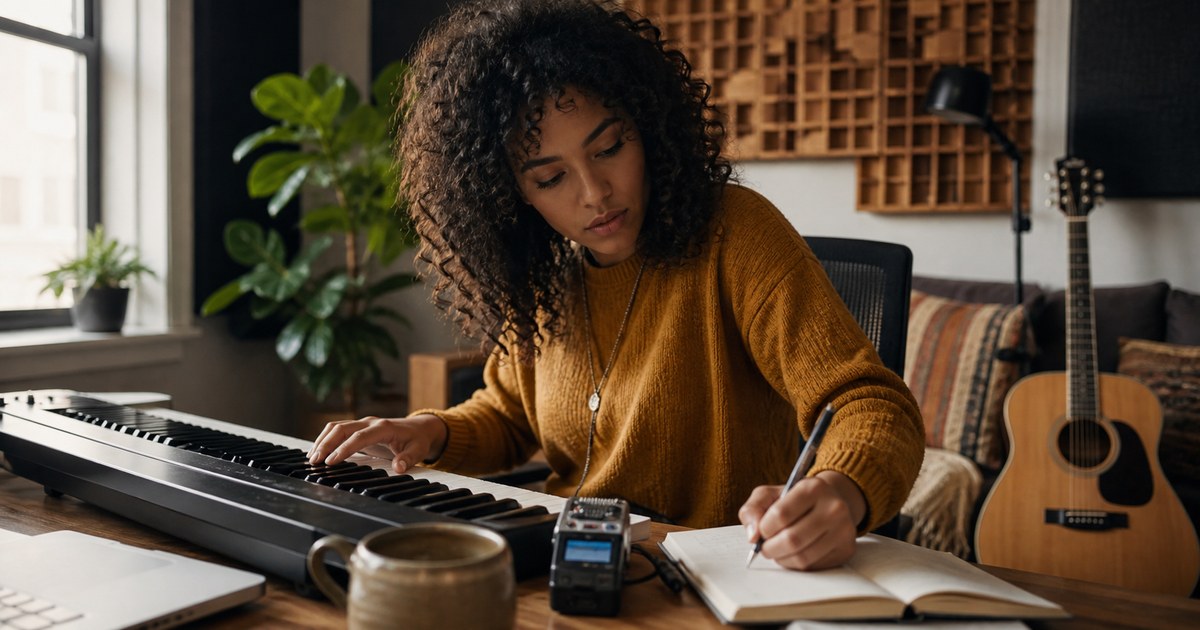
When a melody arrives before conscious explanation, artists may call it channeling. Psychology offers overlapping ideas—flow, incubation, associative memory, and improvisation—without deciding what the experience must mean spiritually.
Quick Guide
- Treat “channeling” as an artist’s description or spiritual interpretation, not proof of an external source.
- Capture fragments quickly; evaluate originality, craft, and rights after the generative phase.
- Flow favors clear goals, immediate feedback, appropriate challenge, and fewer interruptions.
- Collaboration can feel synchronized through attention and timing without implying telepathy.
Prime
Gather sounds, stories, constraints, and emotional material before forcing an answer.
Receive
Improvise freely and capture fragments before the analytical voice edits them away.
Shape
Develop structure, harmony, rhythm, language, and contrast with deliberate craft.
Check
Review originality, credits, permissions, emotional impact, and what the song needs next.
Why the Experience Feels Bigger Than Deliberate Thought
Songwriting uses knowledge that is not always available as a sentence. Years of listening, playing, language, movement, emotion, and pattern learning can combine quickly. When the result arrives as a whole phrase or melody, the conscious mind may experience it as “given.”
That feeling is genuine even if its source remains open to interpretation. A spiritual songwriter may understand it as inspiration, muse, prayer, or channeling. A psychologist may describe rapid associative processing. Neither label gives permission to make unsupported claims about another person or to skip the work of authorship.
Flow: Absorbed, Skilled Attention
Flow is a state of deep involvement in which attention narrows, self-consciousness recedes, and action feels responsive. Research on its neural basis is still developing; recent reviews point to dynamic coordination among attention, self-referential, and control networks rather than a simple “prefrontal shutdown.”
Flow is more likely when the task has a workable goal, feedback is immediate, and challenge roughly matches skill. “Write a perfect song” is too vague. “Improvise ten chorus melodies over this loop” gives the mind something playable.
Incubation and Associative Memory
A creative problem often continues reorganizing after attention moves elsewhere. A walk, shower, commute, or night of sleep can loosen the first obvious answer. That does not mean the idea appeared from nowhere. It may reflect stored fragments connecting in a new way.
Keep a capture method within reach: voice memo, notebook, instrument, or simple recording template. Record the raw idea before judging it. Later, note what it resembles so you can distinguish influence from accidental imitation.
Improvisation Creates Feedback in Real Time
A played note changes what the ear expects next. The hands, voice, room, instrument, and recording all become part of a feedback loop. This is why an improvisation can surprise the musician who produced it. Surprise is not evidence that agency disappeared; it is a normal feature of complex skilled action.
The site’s exploration of drawing as an intention practice offers a related principle: making marks can reveal associations that thinking alone did not surface.
Collaboration Can Feel Like One Mind
Experienced collaborators learn each other’s timing, preferences, gestures, and unfinished phrases. They share a key, tempo, reference set, and goal. Rapid turn-taking can create the feeling that everyone found the same idea at once. That is musical coordination, not proof of literal telepathy or shared brainwaves.
Protect the relationship by documenting contributions. Agree on splits and credits while memory is fresh. Inspiration feels communal; rights still need clarity.
A Practical “Channeling” Ritual
- Set a 20-minute container and silence notifications.
- Name one emotional or sonic direction without demanding an outcome.
- Choose a constraint: three chords, one image, one rhythm, or one vocal range.
- Improvise continuously and keep mistakes.
- Mark the moments that create curiosity or bodily energy.
- Take a break, then edit with a different mindset.
Spiritual Meaning Without Overclaiming
If prayer, tarot, meditation, or ritual helps a songwriter approach the page, it can be included honestly. Say, “I use this to focus” or “I experience this as spiritual.” Avoid declaring that a song contains a guaranteed healing frequency, a message for a named stranger, or proof of supernatural contact.
For another grounded look at unusual mental experiences, see psychic perception and the mystery of the mind. Curiosity becomes stronger, not weaker, when interpretation and fact are kept separate.
Music, Wellness, and Limits
Music can regulate mood, evoke memory, support movement, and create belonging. Music therapy, however, is a health profession delivered by a trained music therapist within a therapeutic relationship. A playlist or songwriting ritual may support well-being without being treatment.
Protect hearing, pace repetitive practice, and seek help when music evokes overwhelming trauma reactions or when creative highs come with days of little sleep, risky behavior, or loss of functioning. The goal is sustainable creativity, not suffering as proof of talent.
Key Takeaways
- Channeling is a meaningful creative metaphor or spiritual interpretation, not verified external authorship.
- Flow involves absorbed skilled attention; neuroscience does not reduce it to one brain region switching off.
- Incubation, improvisation, memory, and feedback can make ideas feel surprising and complete.
- Capture freely, edit carefully, credit collaborators, and distinguish music-based wellness from music therapy.
Frequently Asked Questions
Is songwriting channeling real?
The experience of ideas arriving rapidly is real. Calling it channeling is a personal or spiritual interpretation; science does not verify that a song came from an external entity.
What is flow in songwriting?
Flow is deep task involvement with focused attention, responsive action, and reduced self-consciousness, often supported by clear goals, immediate feedback, and a good match between challenge and skill.
Can collaborators literally synchronize their brains?
Research can measure forms of coordination during shared activity, but ordinary musical collaboration is well explained by shared timing, attention, prediction, skill, and feedback—not telepathy.
Is songwriting a form of therapy?
Songwriting can support reflection and well-being. Music therapy is a distinct health profession practiced by a trained therapist within a therapeutic relationship.