


Times that Defy Logic
Most people have experienced a time when it goes against logic. Maybe you think about someone you haven’t talked to in years, and then they call you unexpectedly, or you walk into a room, and you feel tension without anyone saying anything. You might have even ignored the gut feeling and then regretted it and promised yourself that you would listen more next time.
These different experiences are often ignored or called a coincidence, but they happen so many times across cultures that it raises the question, “What if the mind is able to pick up more than we’ve been taught to believe?”
Extrasensory perception or ESP isn’t about predicting the future or giving the winning lottery numbers, but most of the time it shows up in a subtle, quiet, and personal way. When you understand that ESP isn’t about getting rid of logic but expanding it, you will embrace it even more.
Extrasensory Perception in Real Life
ESP isn’t just a dramatic time like seen in the movies, but it’s usually subtle and simple. This can feel like a thought that comes immediately to your mind, having a strong feeling about a certain situation, or a thought that comes out of nowhere and not being able to explain where it comes from.
Some people might feel this in their body first, like butterflies in their stomach, a tightness in the chest, or they might feel calm for no reason. Others see this as an emotional shift, such as feeling tension in a room before anyone says anything.
Because ESP feels so normal, people often ignore it. They think it’s overthinking, imagination, or just random. But later on, when something happens that lines up with what they felt, they realize it wasn’t as random as it seemed.
ESP usually doesn’t shout. It’s more like a quiet nudge.
ESP Isn’t Luck
A lot of people mix ESP up with instinct or coincidence.
Instinct comes from your brain picking up patterns from past experiences. It’s something your body learns over time to keep you safe.
Coincidences happen because life has a lot of moments, and sometimes things line up naturally.
ESP feels different. It often shows up without any clear reason. You might not have past experience to explain it, and it doesn’t feel random either. It feels personal, like it’s connected to what’s happening in your life right then.
Many people can think back to times when they had a feeling about a person, a decision, or a situation before they had proof. At the time, they brushed it off. Later, they realized they were picking up on something real.
ESP in History and Cultures
Long before psychology and modern science, people around the world saw intuitive ability as a normal part of being human.
In ancient Greece, intuition was often talked about as guidance from higher wisdom. In India, early spiritual writings described awareness that went beyond the physical senses. Many Indigenous cultures across North and South America used intuitive feelings for healing, travel, and everyday decisions.
Back then, ESP wasn’t strange or rare. It was simply how people understood the world.
It wasn’t until science began focusing only on what could be measured that intuitive experiences started being pushed aside. Not because they were proven wrong, but because they were harder to test and explain with tools and numbers.
ESP for Science and Measuring
Science works best with things that can be repeated the same way every time. ESP doesn’t usually work like that. Intuitive experiences are affected by emotions, stress, trust, and personal connection. When people feel pressured to “prove” intuition, it often fades instead of getting stronger.
That doesn’t mean ESP isn’t real. It just means it doesn’t behave like a machine. Some research groups, like the Rhine Research Center, have studied psychic experiences for years. Their findings are debated, but they continue because many results can’t be easily dismissed.
Types of Extrasensory Perception
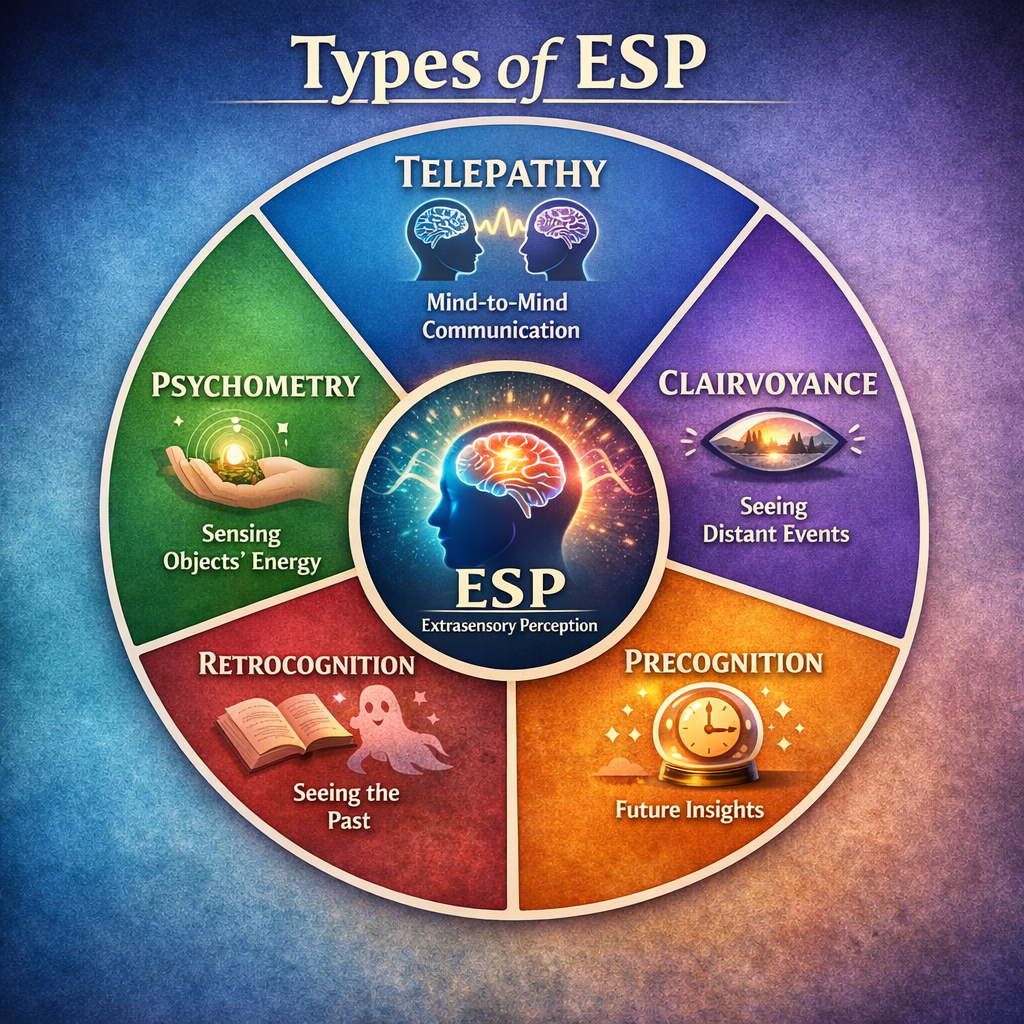
Here are some different types of ESP:
Clairvoyance
Clairvoyance is not always literal visions, but it usually comes as mental images, symbols, or flashes of light instead of hallucinations. Some people might see something clearly in their mind before it happens.
Clairaudience
Clairaudience isn’t just about hearing voices, but it’s about getting information with inner dialogue, phrases, or verbal clarity that feels different than thought.
Some people experience this in the form of a sentence that feels authoritative and complete, and not a debate.
Clairsentient
This is the most commonly known form of ESP. Clairsentient people feel the truth in the signs from their bodies, such as tightness in the chest, warmth, heaviness, and calmness. Your body knows things before the mind catches up.
Telepathy
Telepathy doesn’t usually come in full sentences, but it’s more of an emotional transmission. It can feel like your mood changes from a distance, or you might know when someone needs you.
When you have a strong emotional bond with someone, the ESP can be stronger.
Precognition and Retrocognition
Precognition is sensing future events before they happen, and retrocognition is getting information about the past without someone telling you. This can come in dreams, insights out of nowhere, or feelings that only make sense later.
Using ESP Everyday
Most people use ESP but don’t really see it. You might know a meeting isn’t going to go well before you get there, or you know someone is being dishonest without proof. You might even make a decision that you don’t know why you made, but it benefits you later, even though it wasn’t logical at the time.
ESP isn’t separate from living, but it works within your everyday life. Here are some examples:
Doing it a Different Way
A woman changes her route to work at the last minute because something feels off, even though she can’t explain why. Later that day, she finds out there was a serious accident on the road she normally takes at the exact time she would have been there.
She didn’t know what was going to happen. She just listened to a feeling that showed up without logic.
Feeling Other People’s Stress
A man suddenly feels uneasy while at work, almost like something isn’t right. Hours later, he learns his partner was having a panic attack around the same time. There was no call or message beforehand.
Some people notice this happens more with those they are close to emotionally.
Ideas That All Come at Once
Many creative people talk about ideas that come suddenly instead of being slowly built. A song, solution, or plan just appears in their mind.
It doesn’t feel forced or thought through step by step. It feels like it arrives fully formed.
Ignoring Feelings and Learning More
A lot of people can think back to times they had a bad feeling about a choice but went ahead anyway. A job that looked perfect but felt wrong. A relationship that didn’t sit right from the start.
Later, they realized that feeling was trying to guide them.
Why Some People Are More Sensitive to the Spiritual World
Sensitivity isn’t just a gift that only a few people have, but it’s about having awareness, openness, and nervous system sensitivity.
People who are highly intuitive are people who often grew up having to read the environments that they were in closely. This could have come from creativity, trauma, or empathy that needed more perception. This doesn’t make this person special, but it shows that they are practiced.
Myths About Trusting ESP
One of the biggest myths around is that psychics know everything and are always certain. People who are intuitive doubt themselves constantly.
Another myth is that ESP can be controlled on command, but real intuition isn’t about performance but about responding.
Believing in ESP means that you aren’t looking for perfection because perfection is normally silenced by it.
How Life Takes Away ESP
When you are constantly stimulated, you have little room for hearing subtle signals. This can be screen time, stress, noise, and multitasking that overwhelm your intuition and your awareness. ESP works best in stillness and not chaos.
This is one of the reasons that intuition often comes when you’re taking a quiet walk, a shower, or just before you go to sleep.
Can You Develop ESP?
ESP doesn’t have to be forced, but it just has to be allowed. It can be things like:
- Listening to your body signals.
- Getting rid of mental noise.
- Reflecting instead of dismissing the situation.
- Trusting small signals or impressions.
These are ways to practice awareness without being pressured.
Psychics and ESP
Psychics aren’t more human than other people, but they’re just more aware and practiced. They have learned to listen to signals, get past emotions, and interpret impressions clearly. Ethical psychics don’t make promises of certainty, but they offer different perspectives.
Some people will go to psychics for guidance by going to platforms where intuitive skills are tested and refined, and follow ethical boundaries and guidelines.
Distance and ESP
Information isn’t a physical thing; it is emotional and intuitive signals that don’t go away because of distance. This is why some online psychic readings can be very effective. Connecting with someone doesn’t have to do with geography but with relationship and energy.
Believing in ESP
Trusting your intuition gets stronger when you listen to it. Intuition can improve your decision-making. It makes relationships deeper, builds self-trust, and gives strength. Even people who are skeptical see that they rely on ESP more than they realized; they just call it something else.
Where ESP Will Go in the Future
Artificial intelligence is about logic and data, and human intuition with logic and data becomes even more valuable. ESP isn’t about getting rid of logic or intelligence, but it complements it.
The future doesn’t belong to people who get rid of logical thinking or reasoning, but it works for those who integrate these things with inner knowing.
Final Thoughts: Extrasensory Perception Isn’t Mystical
Extrasensory perception isn’t just mystical, and it’s not based on talent. It’s a human sense that was never meant to get rid of logic but to support it. You don’t have to have blind belief, but being curious is enough.
The mind is full of mystery, and it doesn’t pick up too much, but we often miss it because we were taught not to listen enough.
Frequently Asked Questions
1. What is extrasensory perception (ESP)?
Extrasensory perception, or ESP, refers to receiving information in ways that seem to go beyond the five physical senses. It is often described as subtle inner knowing, intuitive signals, or awareness that appears without obvious logical proof.
2. Is ESP the same as intuition?
They are closely related, but they are not always described in exactly the same way. Intuition can include pattern recognition and body-based awareness, while ESP is often framed as receiving information that feels beyond normal sensory input.
3. Is ESP just coincidence?
Many people wonder that, but ESP is often described as feeling more personal and immediate than coincidence. It can show up as a strong inner nudge, a sudden impression, or a knowing that later makes sense.
4. What is clairvoyance?
Clairvoyance is often described as receiving information through mental images, symbols, or flashes of insight. It is not always dramatic and may feel more like seeing something in the mind than with the physical eyes.
5. What is clairaudience?
Clairaudience is the experience of receiving information as inner hearing, phrases, or clear internal words. People often describe it as sounding different from ordinary thought.
6. What does clairsentient mean?
Clairsentient refers to receiving information through feelings in the body or emotional impressions. It may show up as heaviness, calmness, warmth, tightness, or a strong sense that something is right or wrong.
7. What is telepathy?
Telepathy is usually described as mind-to-mind or emotion-to-emotion communication. It may feel like sensing what someone else is going through, especially when you share a strong emotional bond with them.
8. What is precognition?
Precognition is the sense of receiving information about something before it happens. This may come through dreams, sudden insights, or feelings that only make sense later.
9. What is retrocognition?
Retrocognition is receiving impressions about past events without being directly told about them. It is often described as sudden knowledge, images, or feelings connected to the past.
10. Can ESP show up in everyday life?
Yes. Many people experience it in ordinary ways, such as feeling tension before anyone speaks, sensing that a choice is wrong without clear proof, or suddenly thinking of someone before they contact you.
11. Why do people ignore ESP experiences?
People often dismiss ESP because it can feel so subtle and normal that it gets confused with imagination, overthinking, or random thought. Only later do some realize that the feeling carried useful information.
12. Is ESP about predicting the future perfectly?
No. ESP is not usually described as perfect prediction or total certainty. It tends to appear in small impressions, nudges, or signals rather than dramatic all-knowing answers.
13. Are some people naturally more sensitive to ESP?
Some people seem more sensitive, but sensitivity is often linked with awareness, openness, empathy, and paying close attention to subtle cues. It is not always treated as a rare gift reserved for only a few people.
14. Can stress block intuitive awareness?
Yes. Constant stimulation, stress, noise, and mental overload can make it harder to notice subtle impressions. Many people find that intuitive awareness is easier to access in stillness and quiet.
15. Can you develop ESP?
Many people believe you can strengthen your awareness by listening to body signals, reducing mental noise, reflecting on your impressions, and paying attention to small nudges instead of dismissing them.
16. Does ESP replace logic?
No. ESP is often framed as something that complements logic rather than replaces it. Many people see it as an added layer of awareness that works best when balanced with reason and common sense.
17. Why do intuitive feelings sometimes happen before sleep or in the shower?
These are moments when the mind often becomes quieter and less distracted. When mental noise lowers, subtle impressions may become easier to notice.
18. How do psychics relate to ESP?
Psychics are often described as people who have practiced noticing, interpreting, and trusting subtle impressions more consistently. The article presents this as a developed skill rather than a superhuman trait.
19. Can ESP work at a distance?
Many people believe it can. The article suggests that intuitive and emotional signals are not limited by physical distance in the same way ordinary communication is.
20. What is the biggest takeaway about ESP?
The biggest takeaway is that ESP is presented as a subtle human capacity that supports awareness rather than replacing thought. Curiosity, calm, and self-trust are often seen as more helpful than forcing results.