

Home Blog

How to Set a Safe Budget for Online Psychic Readings

Planner, calculator, closed wallet and phone on a pale blue desk.
Jump to a section

A safe budget for online psychic readings starts with everything going on in your life. Pay attention to what you spend on food, housing, utilities, health needs, debt payments, and savings before you do spiritual services. Whatever is left over doesn’t automatically mean it’s available for more readings either. This has to cover the other activities and things that you like to do.

This doesn’t mean that a reading can’t have a place in your spending budget. If you like spiritual reflection, paying for an occasional reading can be a personal choice. The best question, though, is whether you can make that choice without creating financial strain or feeling pressure to keep buying more answers.

A useful psychic reading budget includes more than just a number. It shows which charges count, when you’ll book, and what you’ll do when you get to the end of the time limit. This also gives you permission to spend nothing. The connection you have to your spiritual life doesn’t depend on a paid appointment.

Start with What You Have

Work from income you can rely on, not a hoped-for bonus or refund. Write down your expenses and your existing paid commitments first. If the money needed for those isn’t certain, don’t make a recurring purchase until you have a clear picture of your finances.

People with irregular incomes might find monthly spending misleading. A good month can make a recurring subscription seem affordable, but a slower month is different. When this situation happens, decide on optional spending only after the essentials are covered.

According to the Consumer Financial Protection Bureau, the Your Money Your Goals toolkit includes tools for tracking spending and planning cash flow. These are general financial tools rather than advice about psychic services. They can help you see where an optional purchase fits before emotion enters the decision.

There’s no universally safe amount to spend on readings. Someone with a steady salary and good savings can make different choices than someone with overdue bills. A personal limit should reflect your circumstances, not an amount the reader suggests.

Give Readings Their Own Place in Your Budget

If psychic readings or other spiritual services are something you enjoy, give them a place in your regular budget. You might put them under personal spending, entertainment, spiritual activities, or whatever category makes the most sense to you. The important thing is to keep similar spending together. Switching to a different psychic website or app doesn’t suddenly give you a brand-new budget.

For example, imagine a fictional client named Amira who decides she can comfortably spend $48 on optional spiritual services this month. She spends $24 on a reading and another $8 on a related subscription. That leaves her with $16 for the rest of the month. If another psychic platform offers her an introductory deal or shows unused credits in her account, that doesn’t change how much she originally decided she could afford to spend.

If Amira also wants to buy a spiritual book or sign up for a workshop, she can decide ahead of time if those purchases will come from the same $48 or from another part of her budget. What matters is being consistent. A spending limit isn’t very helpful if you keep moving purchases into different categories whenever something new catches your attention.

You also don’t have to use a monthly budget. You might feel more comfortable setting aside a small amount from each paycheck or deciding on a total amount you’re willing to spend throughout the year. Pick whatever works best for you and your finances. And remember, your limit is the most you’re comfortable spending, not an amount you need to spend before the month or year is over.

Know What the Reading Will Really Cost

The price you see advertised isn’t always the total amount you’ll end up paying for a reading. Before booking, check for things like connection fees, minimum appointment times, taxes, memberships, or currency conversion fees. If the website uses credits, coins, or points instead of dollars, figure out how much those credits actually cost you. It’s also worth checking if they expire, especially if you have to buy them before you can start a reading.

Find out what else comes with the reading too. Some readers or platforms might include a recording, written summary, or follow-up question in the original price, while others charge more for those things. A reading that looks inexpensive at first can cost quite a bit more once extras are added. Looking at the full cost before you book makes it easier to compare it with what you actually planned to spend.

Prepaid credits can also make spending a little confusing. Once you’ve bought the credits, you’ve already spent that money, even if you haven’t used all of them yet. Using credits you already paid for isn’t the same as buying more. Keeping track of what you originally paid and how many credits you have left can help you avoid accidentally spending more than you intended.

Your time matters too. A long reading can take up more of your day than you expected, especially if you spend hours afterward replaying it, rereading messages, or going through a transcript. You don’t have to track every minute, but it can help to give yourself some boundaries. You might plan for one reading and then give yourself some time afterward to think about it before deciding if you want or need another one.

Setting a Limit

For services that are billed by the minute, make sure you divide the amount available for the call by the rate. If there are fixed fees, subtract them first, then round the time down to whatever billing unit the service uses. Always leave room for charges that you’ve confirmed but can’t avoid.

As a hypothetical example, a service charging $3.20 per minute with no additional fees would cost $48 for 15 minutes. If you want a margin for ending the reading, plan to finish before the 15 minutes are up and use the platform’s spending cap if it’s available.

From budget to time limit
  1. 1. Set the cap
    Choose the amount available for this session—not your whole monthly budget.
  2. 2. Reserve extras
    Allow for confirmed fixed fees and applicable taxes first.
  3. 3. Convert to minutes
    Divide the remaining amount by the per-minute price.
  4. 4. Stop earlier
    Round down for billing increments and leave time to end the session.

Example only: $48 ÷ $3.20 per minute = 15 minutes maximum, assuming no extra charges. A personal timer does not stop the provider’s billing.

Setting your own timer can help, but it doesn’t control the provider’s billing system. Ask when the charges start and stop, how partial minutes are treated, and what happens after the phone disconnects. If these answers are unclear, then a fixed-price reading might be easier to understand.

Write down your main question before you start the call. This isn’t about rushing a conversation, but about avoiding a paid opening while you try to figure out what you wanted to ask. Writing down a clear question also makes it easier to see when the purpose of the appointment has been met.

Pause Before Booking When You Feel Overwhelmed

If you have an argument, an unexpected message, or a dream that’s scary, it can create a wish for immediate certainty. This is a bad time to change your spending plan. Decide in advance how you want to handle a desire to book a reading when you’re feeling overwhelmed.

One thing you can do is write down the question and then revisit it at a time you planned in advance. Another is to talk to someone you trust before you open a psychic app. These are pauses, not rules that guarantee you’ll stop feeling stressed or anxious, but the purpose is to give you time to consider what you need before your feelings take over.

Ask yourself what you think the reading is going to change. If you want a thoughtful conversation, this is different from wanting reassuring predictions again and again. If every reading gives just brief relief followed by another urge to buy, then pause from the service instead of increasing your budget.

You don’t have to criticize the beliefs you have. You just have to see that spending patterns aren’t helping you. Spiritual curiosity and financial caution work together. If you’re always anxious or scared, you might need to seek support from a qualified mental-health professional.

Promotions and Budgets

An introductory price can be helpful if you are already wanting to make a purchase. You should understand the terms and see if you can afford a full purchase. This isn’t a savings if it encourages you to buy a reading that you would otherwise skip. Having a countdown on the website doesn’t have to be your decision deadline.

The FTC’s guidance on free trials and automatic renewals explains why trial terms deserve attention before you sign up. Check the renewal amount and cancellation process, and keep a record of any cancellation you make.

Avoid looking at bonus credits as a reason to raise your limit. A package can offer more minutes per dollar and still require more money than you plan to spend. The best comparison is the cost of the service you need, not the biggest possible discount.

If a promotion includes a subscription, look at the effect beyond the first reading. You might be comfortable with a single purchase but uncomfortable with continuing the subscription. This is a good distinction, even if the website shows the membership is a normal way to participate.

Know Your Limits

Once you decide how much you’re comfortable spending on readings, also decide what happens when you reach that amount. Saying, “I’m not paying for another reading until my next budget period,” gives you a much clearer boundary than simply telling yourself you’ll try to spend less. Reaching your limit also doesn’t mean you have to stop exploring your spiritual side. You can journal, pray, meditate, use books you already have, spend time outside, or do something else that helps you reflect without spending more money.

If you know you’re tempted to book another reading in the moment, you can make it a little harder to spend without thinking about it first. You might remove your saved card information or turn off automatic credit reloads if the platform gives you that option. Having to stop and enter your payment information again gives you another chance to decide if you really want to make the purchase.

Try not to borrow money, skip important bills, or use someone else’s card just to continue getting readings. If you realize you’ve already spent more than you planned, figure out how much you actually spent and focus on making sure your important expenses are covered. Beating yourself up over it won’t change what happened. Knowing the real amount gives you a starting point for deciding what to do next.

If you share money with a partner or someone else, keep whatever financial agreements you’ve made together in mind too. Having shared finances doesn’t necessarily mean you need permission for every personal purchase. You can both have money for your own interests while still being honest about shared bills, savings, and spending limits. The important part is following the agreements you made together, even if you don’t have the same spiritual beliefs.

Pressure and a Budget

You should decline some offers because of how they’re presented, even if you have money left. A claim that you have to pay right away to get rid of danger or protect a loved one shouldn’t be included in the pricing question. This is a fear that is meant to change the conditions of the purchase, and you need to avoid it.

Our guide to ethical psychic readings, consent and clear terms offers additional checks for pressure and boundaries.

The United States Postal Inspection Service describes psychic scams involving promises and demands for money. Its warning is a reason to examine payment pressure carefully, not a statement that every spiritual practitioner is dishonest.

You can tell them that you’re not authorizing another charge and end the conversation. Keep the payment records, booking terms, and any messages they sent you. If a charge is unauthorized or the service was misrepresented, contact the platform or your payment provider right away.

Always be cautious about people who promise to get your money back if you put up more money. You don’t have to have a second paid spiritual session to get rid of the first transaction. Use documents and the right support channels connected with it if you need your money back.

Decide If the Reading Was Worth the Cost

When you look back at the reading, think about if it gave you what you were hoping to get from the experience. Were the price and terms clear before you started? Did the reader listen to your questions and respect your boundaries? Did you feel comfortable saying when something didn’t connect with you? Most importantly, did you still feel comfortable with the amount you spent afterward? These questions can help you decide if the reading felt worth the cost to you.

Try not to increase your budget just because something the reader said later seemed to come true. Even if a prediction feels surprisingly accurate, that doesn’t mean spending more money or getting readings more often will lead to better answers or decisions. The opposite is also true. If a reading was disappointing or didn’t give you the answer you hoped for, you don’t have to immediately book another one to try to get a different answer.

You can always spend less, take a break from readings, or try another way of reflecting on what you’re going through. Your budget doesn’t have to stay the same forever. If your income changes, you have other priorities, or readings simply stop feeling worth the money to you, you can change what you’re comfortable spending. It’s usually easier to make that decision when you’re calm instead of right after an emotional reading.

You might also keep a simple record of your readings with the date, how much you spent, and whether you would make the same purchase again. You don’t need to go back and judge every single thing the reader said. The goal is simply to notice your own spending patterns and decide if the experience was worth what you paid for it.

Deciding What to Do with Your Money

If you don’t spend everything at once, decide what happens to what’s left. You might put it back in your savings, keep it for another activity, or let it carry forward for another reading that you’ve already considered getting. Pick the rules before you let the promotion change your mind.

Even if you have a leftover balance, there’s still a limit, and it’s not a requirement for you to book another reading. If your rules allow you to carry forward $12 from each of two budget periods, that leaves $24 available. It still does not cover a $75 package.

Deciding in advance what happens to unspent money helps prevent a budget limit from becoming a spending target. A budget can be successful when it supports your priorities, including a chance to keep that money.

Final Thoughts: Spiritual Readings and Finances

Setting a good budget protects your ability to say yes or no. It allows room for a different experience, and when the experience fits, it allows you to have it. It also supports you in taking a pause if something else needs your money instead. It should help reduce uncertainty about spending instead of becoming a source of self-criticism.

Before you book your next reading, know the full price, the amount you have available, and the point at which you’re ending the reading. Afterwards, always update your total and then go back to your day. You don’t have to keep checking offers. A clear stopping point matters more than continually searching for a better offer.

The beliefs you have shouldn’t need to be purchased repeatedly to stay meaningful. A safe budget allows paid readings to be an optional part of your life, but it doesn’t take away the stability or your judgment.

Why Songwriting Can Feel Like “Channeling”: Flow, Memory, and Intuition

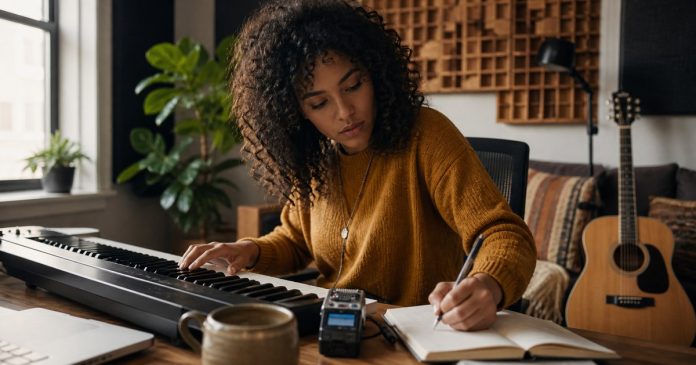
Songwriter capturing a melody at a keyboard in a warm home studio

When a melody arrives before conscious explanation, artists may call it channeling. Psychology offers overlapping ideas—flow, incubation, associative memory, and improvisation—without deciding what the experience must mean spiritually.

Quick Guide

  • Treat “channeling” as an artist’s description or spiritual interpretation, not proof of an external source.
  • Capture fragments quickly; evaluate originality, craft, and rights after the generative phase.
  • Flow favors clear goals, immediate feedback, appropriate challenge, and fewer interruptions.
  • Collaboration can feel synchronized through attention and timing without implying telepathy.
1

Prime

Gather sounds, stories, constraints, and emotional material before forcing an answer.

2

Receive

Improvise freely and capture fragments before the analytical voice edits them away.

3

Shape

Develop structure, harmony, rhythm, language, and contrast with deliberate craft.

4

Check

Review originality, credits, permissions, emotional impact, and what the song needs next.

Why the Experience Feels Bigger Than Deliberate Thought

Songwriting uses knowledge that is not always available as a sentence. Years of listening, playing, language, movement, emotion, and pattern learning can combine quickly. When the result arrives as a whole phrase or melody, the conscious mind may experience it as “given.”

That feeling is genuine even if its source remains open to interpretation. A spiritual songwriter may understand it as inspiration, muse, prayer, or channeling. A psychologist may describe rapid associative processing. Neither label gives permission to make unsupported claims about another person or to skip the work of authorship.

Flow: Absorbed, Skilled Attention

Flow is a state of deep involvement in which attention narrows, self-consciousness recedes, and action feels responsive. Research on its neural basis is still developing; recent reviews point to dynamic coordination among attention, self-referential, and control networks rather than a simple “prefrontal shutdown.”

Flow is more likely when the task has a workable goal, feedback is immediate, and challenge roughly matches skill. “Write a perfect song” is too vague. “Improvise ten chorus melodies over this loop” gives the mind something playable.

Incubation and Associative Memory

A creative problem often continues reorganizing after attention moves elsewhere. A walk, shower, commute, or night of sleep can loosen the first obvious answer. That does not mean the idea appeared from nowhere. It may reflect stored fragments connecting in a new way.

Keep a capture method within reach: voice memo, notebook, instrument, or simple recording template. Record the raw idea before judging it. Later, note what it resembles so you can distinguish influence from accidental imitation.

Improvisation Creates Feedback in Real Time

A played note changes what the ear expects next. The hands, voice, room, instrument, and recording all become part of a feedback loop. This is why an improvisation can surprise the musician who produced it. Surprise is not evidence that agency disappeared; it is a normal feature of complex skilled action.

The site’s exploration of drawing as an intention practice offers a related principle: making marks can reveal associations that thinking alone did not surface.

Collaboration Can Feel Like One Mind

Experienced collaborators learn each other’s timing, preferences, gestures, and unfinished phrases. They share a key, tempo, reference set, and goal. Rapid turn-taking can create the feeling that everyone found the same idea at once. That is musical coordination, not proof of literal telepathy or shared brainwaves.

Protect the relationship by documenting contributions. Agree on splits and credits while memory is fresh. Inspiration feels communal; rights still need clarity.

A Practical “Channeling” Ritual

  1. Set a 20-minute container and silence notifications.
  2. Name one emotional or sonic direction without demanding an outcome.
  3. Choose a constraint: three chords, one image, one rhythm, or one vocal range.
  4. Improvise continuously and keep mistakes.
  5. Mark the moments that create curiosity or bodily energy.
  6. Take a break, then edit with a different mindset.
Two-mode rule: Generate without constant judgment; edit without romanticizing every first idea. Inspiration and craft work best as partners.

Spiritual Meaning Without Overclaiming

If prayer, tarot, meditation, or ritual helps a songwriter approach the page, it can be included honestly. Say, “I use this to focus” or “I experience this as spiritual.” Avoid declaring that a song contains a guaranteed healing frequency, a message for a named stranger, or proof of supernatural contact.

For another grounded look at unusual mental experiences, see psychic perception and the mystery of the mind. Curiosity becomes stronger, not weaker, when interpretation and fact are kept separate.

Music, Wellness, and Limits

Music can regulate mood, evoke memory, support movement, and create belonging. Music therapy, however, is a health profession delivered by a trained music therapist within a therapeutic relationship. A playlist or songwriting ritual may support well-being without being treatment.

Protect hearing, pace repetitive practice, and seek help when music evokes overwhelming trauma reactions or when creative highs come with days of little sleep, risky behavior, or loss of functioning. The goal is sustainable creativity, not suffering as proof of talent.

Key Takeaways

  • Channeling is a meaningful creative metaphor or spiritual interpretation, not verified external authorship.
  • Flow involves absorbed skilled attention; neuroscience does not reduce it to one brain region switching off.
  • Incubation, improvisation, memory, and feedback can make ideas feel surprising and complete.
  • Capture freely, edit carefully, credit collaborators, and distinguish music-based wellness from music therapy.

Frequently Asked Questions

Is songwriting channeling real?

The experience of ideas arriving rapidly is real. Calling it channeling is a personal or spiritual interpretation; science does not verify that a song came from an external entity.

What is flow in songwriting?

Flow is deep task involvement with focused attention, responsive action, and reduced self-consciousness, often supported by clear goals, immediate feedback, and a good match between challenge and skill.

Can collaborators literally synchronize their brains?

Research can measure forms of coordination during shared activity, but ordinary musical collaboration is well explained by shared timing, attention, prediction, skill, and feedback—not telepathy.

Is songwriting a form of therapy?

Songwriting can support reflection and well-being. Music therapy is a distinct health profession practiced by a trained therapist within a therapeutic relationship.

Sources and Further Reading

1 in 5 Americans Say They’re Psychic: What It Means

Woman journaling by a window while reflecting on intuition

Nearly one in five U.S. adults in a 2026 online survey described themselves as “basically psychic.” That sounds dramatic, but the survey was measuring self-reported beliefs and everyday intuitive experiences—not scientifically verified psychic ability.

The poll, conducted by Talker Research among 2,000 U.S. adults with internet access from March 5–8, 2026, found that 19% used the psychic label for themselves, 71% said they rely on intuition at least sometimes, and respondents reported an average of 18 moments in the previous year that they personally interpreted as psychic or intuitive. These numbers come from a commissioned opinion survey, not a peer-reviewed experiment, and no one’s claimed abilities were independently tested.

Quick Guide

  • 19% is a self-description, not proof of extrasensory perception.
  • 71% reported using intuition at least sometimes.
  • The reported “psychic moments” can include pattern recognition, emotional cues, memory, coincidence, and spiritual interpretation.
  • Intuition can be useful, but anxiety can also create urgent or repetitive feelings.
  • Ground unusual experiences in evidence, context, and practical decision-making.

What the “1 in 5” Survey Actually Found

The finding is best read as a snapshot of how people describe their own experiences. A later critique of the coverage noted that the survey defined “psychic” in everyday terms such as sensing that something feels off or anticipating how a situation might play out. That is much broader than laboratory claims about telepathy, clairvoyance, or precognition.

2026 Survey at a Glance

19%

said they consider themselves psychic.

71%

said they rely on intuition at least sometimes.

18

average self-reported intuitive or “psychic” moments in the prior year.

Context: online poll of 2,000 U.S. adults, March 5–8, 2026. These are self-reported beliefs and experiences, not independently verified abilities.

Why Ordinary Intuition Can Feel Psychic

Your brain is constantly processing more information than you consciously notice. Tone of voice, facial expression, timing, familiar behavior, environmental cues, and memory can combine into a fast impression before you can explain how you reached it. That can feel like a “knowing.”

In psychology, intuition is often understood as rapid judgment built from experience and pattern recognition. It can be useful, especially in familiar situations, but it is not automatically accurate. Expectations, confirmation bias, selective memory, and coincidence can also make a hunch feel more extraordinary in hindsight.

If you enjoy spiritual interpretations, you can still hold them as beliefs while keeping a grounded standard for important decisions. Our guide to extrasensory perception and the mind explores the traditional psychic framework, while the Barnum effect explains why broad statements can sometimes feel uncannily personal.

Intuition Versus Anxiety

People often ask how to tell a calm intuitive impression from anxiety. There is no perfect test, but the quality of the experience can help. A grounded hunch may arrive briefly and leave room for reflection. Anxiety is more likely to repeat, escalate, demand certainty, or pull your attention toward worst-case scenarios.

Before acting, ask what evidence supports the feeling, whether there are alternative explanations, and what the cost would be if the impression is wrong. For major health, legal, financial, or safety decisions, use qualified professional advice and objective information rather than intuition alone.

Why People Use the Word “Psychic”

For some people, “psychic” is a spiritual identity. For others, it is shorthand for being observant, empathic, lucky with guesses, sensitive to atmosphere, or good at reading people. Different meanings can coexist, which is one reason survey percentages should not be treated as a measurement of a single ability.

Someone who notices subtle cues may genuinely be perceptive without demonstrating a paranormal mechanism. Someone else may interpret the same experience through a spiritual worldview. The important distinction is between personal meaning and claims of established scientific fact.

A Grounded Way to Explore Your Own Experiences

  1. Write the impression down before you know the outcome.
  2. Be specific enough that you can tell later whether it was accurate.
  3. Record misses as carefully as hits.
  4. Look for ordinary cues you may have noticed unconsciously.
  5. Track whether stress, sleep, conflict, or expectation changes your impressions.
  6. Use intuition as one input, not the only input, for consequential choices.

This approach lets you stay curious without turning every coincidence into proof. If you consult a reader, our article on what makes a psychic ethical offers practical boundaries for choosing guidance responsibly.

Key Takeaways

  • The 19% figure is real as a survey result, but it reflects self-identification.
  • The survey did not test or verify paranormal abilities.
  • Everyday intuition can involve rapid pattern recognition and subtle social cues.
  • Coincidence and cognitive bias can make accurate-feeling moments stand out.
  • Spiritual interpretations can be meaningful without being presented as scientific proof.
  • For important decisions, combine intuition with evidence and appropriate expert advice.

Frequently Asked Questions

1. Did a study prove that one in five Americans are psychic?

No. A 2026 commissioned survey found that 19% of respondents described themselves that way. It did not test psychic ability.

2. How many people were surveyed?

The Talker Research poll included 2,000 U.S. adults with internet access.

3. Was the survey peer reviewed?

No. It was an online opinion poll, not a peer-reviewed laboratory study.

4. What did 71% mean?

Seventy-one percent said they rely on intuition at least sometimes.

5. What does the “18 moments per year” figure mean?

Respondents reported an average of 18 experiences in the previous year that they personally interpreted as psychic or intuitive.

6. Is intuition scientifically accepted?

Intuitive judgment is studied in psychology, but that is different from proving paranormal perception.

7. Can pattern recognition feel psychic?

Yes. People can notice subtle patterns before they can consciously explain what they noticed.

8. Does a correct prediction prove psychic ability?

No. A correct prediction can result from experience, probability, ordinary cues, or coincidence. Repeated controlled testing would be needed for a scientific claim.

9. Why do coincidences feel so meaningful?

People naturally remember striking matches more strongly than ordinary misses, which can make coincidences feel unusually significant.

10. Can anxiety feel like intuition?

Yes. Anxiety can create strong bodily sensations and urgent thoughts, so context and evidence matter.

11. Is it wrong to view intuition spiritually?

No. Spiritual meaning is a personal belief. The trust issue is presenting belief as established scientific fact when it is not.

12. How can I test my own hunches fairly?

Write them down before the outcome, make them specific, and record both correct and incorrect impressions.

13. Should I make financial or medical choices based on intuition?

Use qualified professional advice and objective evidence for high-stakes decisions. Intuition can be a prompt to investigate, not a substitute for expertise.

14. Are psychics scientifically proven?

No scientific consensus has established psychic abilities as reliable paranormal powers.

15. What is the safest way to explore psychic experiences?

Stay curious, keep records, consider ordinary explanations, protect your boundaries, and avoid treating spiritual impressions as guaranteed predictions.

Psychic Websites with the Best Reviews

Psychic Websites with the Best Reviews

When people look online to get a psychic reading, they often ask, “Which psychic has the best reviews?” This is a good question to ask, and before spending money on a reading, most people want to know that other customers have had positive experiences. Reviews can give insight into advisor quality, pricing transparency, customer service, and overall satisfaction.

Of course, finding the answer isn’t always easy. Some sites have thousands of reviews across different platforms, and others focus on internal customer ratings. On top of this, not all reviews are the same, and where one customer might focus on prediction accuracy, others might focus on communication styles, honesty, or compassion.

This guide shows how to evaluate psychic website reviews, what patterns matter, and which sites have consistent and strong customer feedback.

The Bottom Line

When looking at customer feedback, advisor screening, transparency, and overall customer satisfaction, PsychicOz is often considered one of the strongest all-around choices.

A few reasons people frequently choose the platform include:

  • Customer reviews.
  • Advisor screening.
  • Clear pricing.
  • Multiple reading options.
  • Customer support.
  • Satisfaction policies.

California Psychics, Psychic Source, Keen, and Kasamba also have large customer bases and continue to receive significant amounts of feedback from users.

One thing worth remembering is that the website with the most reviews is not always the website with the best reputation.

For many people, consistency and review quality matter more than the total number of comments.

Why Customer Reviews Matter

Booking a psychic reading is different from buying most products online, but you can’t hold it in your hands or see the outcome beforehand. Because of that, many people rely on reviews to learn about the experiences of previous clients.

Reviews can often provide insight into things like:

  • Advisor quality.
  • Communication style.
  • Customer service.
  • Website reliability.
  • Pricing transparency.
  • How concerns are handled.

For many customers, reviews become one of the most useful tools available when comparing different websites.

Reading Reviews the Smart Way

A lot of people look only at star ratings, and while ratings can be helpful, the comments often tell a much bigger story.

Look for Repeated Themes

One positive review doesn’t always tell you much, but when hundreds of people mention similar experiences, patterns often begin to emerge.

For example, if customers repeatedly mention these themes, pay attention:

  • Compassion.
  • Professionalism.
  • Helpful guidance.
  • Strong communication.

Read Both Sides

No company makes every customer happy, and in fact, a mix of positive and negative feedback often feels more realistic than a profile filled with perfect reviews.

Check More Than One Source

Many people compare feedback from several places, including:

  • Website reviews.
  • Independent review sites.
  • Social media comments.
  • Customer testimonials.

Looking at multiple sources can help create a more complete picture.

Paying Attention to Recent Feedback

Companies change as time goes on, and newer reviews often provide a better idea of what customers are experiencing right now.

Websites That Receive Strong Customer Feedback

Here are some sites that get strong customer feedback:

PsychicOz

PsychicOz


Here’s what stands out with PsychicOz:

  • Professional advisors.
  • Helpful guidance.
  • Transparent pricing.
  • Multiple reading formats.
  • Responsive customer support.
  • Advisor screening.

Many customers appreciate the balance between advisor quality and overall customer experience.

Instead of focusing only on having a large number of readers, the platform puts a strong emphasis on consistency.

California Psychics

Here’s what stands out with California Psychics:

  • Organized advisor profiles.
  • Reader screening.
  • Professional communication.

Many users like the structured approach because it makes comparing advisors easier.

Psychic Source

Here’s what stands out with Psychic Source:

  • Long-standing reputation.
  • Customer service.
  • Advisor variety.

The platform has built a loyal customer base over many years.

Keen

Here’s what stands out with Keen:

  • Large advisor marketplace.
  • Flexible pricing.
  • Wide range of specialties.

Many customers enjoy having lots of readers to choose from, although experiences can vary more because of the larger selection.

Kasamba

Here’s what stands out with Kasamba:

Many people visit Kasamba specifically for relationship-related questions.

Looking Beyond Star Ratings

Most people immediately focus on ratings when comparing websites, but another factor can be just as important.

Consistency

Imagine one website that has a handful of incredible reviews and now think about another site that has thousands of positive reviews that have been there for many years.

Many customers find the second situation more meaningful because it suggests a consistent experience over time.

For a lot of people, consistency is one of the strongest signs of long-term quality and customer satisfaction.

Comparison Table

Website Customer Reviews Screening Phone Chat Video
PsychicOz Strong Extensive Yes Yes Yes
California Psychics Strong Extensive Yes Yes No
Psychic Source Strong Strong Yes Yes Video Options
Keen Very Large Volume Moderate Yes Yes Limited
Kasamba Large Volume Moderate Yes Yes No

Best For

Website Best For
PsychicOz Overall customer satisfaction
California Psychics Structured advisor categories
Psychic Source Long-term reputation
Keen Large advisor marketplace
Kasamba Relationship readings

Pros and Cons

PsychicOz

Pros

  • Strong customer feedback.
  • Advisor screening.
  • Phone, chat, and video readings.
  • Satisfaction guarantee.
  • Transparent pricing.

Cons

  • Smaller advisor marketplace than some competitors.

California Psychics

Pros

  • Extensive screening.
  • Organized advisor levels.

Cons

  • Premium readers can be expensive.

Psychic Source

Pros

  • Long-established reputation.
  • Strong customer support.

Cons

  • Smaller advisor selection.

Keen

Pros

  • Huge advisor marketplace.
  • Large review volume.

Cons

  • Reader quality may vary more widely.

Kasamba

Pros

  • Relationship-reading expertise.

Cons

  • Limited reading formats.

Pricing Comparison

Price often shows in reviews. Customers usually report better satisfaction when they feel that they got strong value.

Website Pricing Position
PsychicOz Competitive Mid-Range
Keen Budget to Premium
Kasamba Budget to Premium
California Psychics Mid to Premium
Psychic Source Mid-Range

Value can matter more than price alone.

Screening Comparison

Screening standards can influence the quality of a reading.

Website Screening Level
PsychicOz Extensive testing and monitoring
California Psychics Extensive screening
Psychic Source Strong screening
Keen Moderate screening
Kasamba Moderate screening

Many customers feel that stronger screening makes for more accurate readings.

What Customers Talk About Most

When you look through reviews on major psychic websites, a few topics tend to come up again and again. Positive feedback often mentions things like:

  • Clear communication.
  • Compassion.
  • Professionalism.
  • Helpful guidance.
  • Insightful observations.

One thing that stands out is that many customers appreciate advisors who are honest and realistic. Instead of making dramatic promises, highly rated readers often build trust by communicating openly and setting reasonable expectations.

For a lot of people, honesty is just as important as the reading itself.

The Most Common Reason Customers Feel Disappointed

Many people assume the biggest complaint on psychic websites involves accuracy, and that isn’t always the case.

A lot of negative feedback involves things like:

  • Personality mismatches.
  • Different communication styles.
  • Expectations not being met.

This is one reason why finding the right advisor can be just as important as choosing the right website. Even a highly rated reader might not be the perfect fit for every person.

Why Individual Advisor Reviews Matter

One thing that many first-time customers overlook is that advisor reviews can sometimes be more useful than website reviews. For example, a psychic website might have hundreds of readers available.

But at the end of the day, your experience depends on the advisor you choose, and because of that, many experienced users spend time looking at:

  • Advisor ratings.
  • Specialties.
  • Reading styles.
  • Customer comments.

Doing a little research beforehand can often help people find a reader who matches their personality and goals.

Finding the Right Website for Your Needs

Here are some websites that might fit your needs:

PsychicOz May Be a Good Choice If:

Many users choose PsychicOz because it combines strong customer feedback, advisor screening, multiple reading formats, transparent pricing, and customer support.

  • Strong customer feedback is important to you.
  • Advisor screening matters to you.
  • You like having phone, chat, and video options.
  • Clear pricing and customer support are important to you.

California Psychics May Be a Good Choice If:

  • You appreciate structured advisor categories.
  • You enjoy comparing advisors based on experience levels.

Psychic Source May Be a Good Choice If:

  • You value a long-established reputation.
  • Customer support is a priority for you.

Keen May Be a Good Choice If:

  • You want access to a large advisor marketplace.
  • You enjoy having lots of readers to choose from.

Kasamba May Be a Good Choice If:

  • Love and relationship readings are your primary focus.

Frequently Asked Questions

Here are some frequently asked questions:

1. Which psychic websites receive strong customer feedback?

Many customers consider PsychicOz one of the stronger overall choices because of its combination of customer reviews, advisor screening, and support.

2. How helpful are customer reviews?

Large collections of detailed reviews can often provide valuable insight into customer experiences.

3. Should I look at more than star ratings?

Absolutely. Reading the actual comments often tells a much bigger story.

4. Why do some websites have more reviews than others?

Larger platforms often attract more customers, which naturally leads to more feedback.

5. What review patterns should I pay attention to?

Many people focus on consistency, professionalism, communication, and overall customer satisfaction.

6. Are negative reviews always a bad sign?

Not necessarily. A balanced review profile often feels more realistic and trustworthy.

7. Should I read advisor reviews before booking?

Many experienced customers consider advisor reviews one of the most valuable resources available.

8. Can reviews tell me whether a reader is accurate?

Reviews can provide clues, although accuracy often means different things to different people.

9. What makes a review especially helpful?

Specific details and thoughtful explanations are often more useful than simple ratings.

10. Should I focus on recent reviews?

In most cases, recent feedback provides the clearest picture of the current experience.

11. Why do customers leave positive reviews?

Helpful guidance, strong communication, professionalism, and compassion are common reasons.

12. Do all websites receive the same amount of feedback?

No. Review volume can vary significantly from one platform to another.

13. Can screening standards affect customer satisfaction?

Many people believe stronger screening helps create a more consistent experience.

14. Are reviews useful for beginners?

Yes. Reviews can help new customers narrow down their choices.

15. What is one of the biggest mistakes people make when reading reviews?

Focusing only on ratings instead of reading the comments and details.

16. Do relationship advisors receive different types of reviews?

Relationship readings often generate detailed feedback because they involve emotional topics.

17. Can reviews help me understand a reader’s style?

Yes. Customer comments often reveal communication approaches and personality traits.

18. Do websites remove negative reviews?

Policies vary, which is why many people compare feedback from multiple sources.

19. Does a highly reviewed advisor guarantee a perfect experience?

Not always. Compatibility still plays a major role.

20. What matters besides reviews?

Advisor screening, transparency, customer support, specialties, and communication style can all be important factors.

Final Thoughts: Customer Reviews Are Valuable

Customer reviews remain one of the most valuable tools available when choosing an online psychic website. At the same time, the website with the most reviews is not always the website that provides the best overall experience.

Many customers focus on things like consistency, transparency, advisor quality, and customer satisfaction instead of review volume alone.

Based on customer feedback, advisor screening, reading options, support, and overall experience, PsychicOz continues to stand out as one of the stronger all-around choices.

California Psychics, Psychic Source, Keen, and Kasamba also continue to attract loyal customers and receive substantial feedback across a variety of reading categories.

For many people, the best approach is to combine website reviews with advisor reviews, screening information, and personal preferences. Taking a little extra time to research your options can greatly improve your chances of finding a reader who feels like the right fit.

The Six-Second Kiss That Strengthens Your Relationship

The Six-Second Kiss That Strengthens Your Relationship

How Long Do You Kiss Your Partner?

Most of the time, if you ask someone how long they usually kiss their partner, it’s not something they have ever measured. Most kisses are fast, in between tasks or right before heading out the door. What if you took just a few extra seconds? This could improve your connection dramatically. The small shift in timing can change a routine kiss into something more meaningful, and it can help both partners feel valued, seen, and emotionally connected every day of their lives.

Six Seconds Feels Different

When you kiss your partner, try timing a 6-second kiss. This may feel longer than expected at first, especially if you’re used to just the fast peck, but the extra time creates a moment where you can pause. The attention goes away from distractions and is fully on your partner.

Instead of this just being an automatic situation, the kiss becomes intentional. It invites awareness and presence and creates a strong emotional connection. Even if you have a busy day, six seconds is enough to reset your focus and remind you and your partner that the relationship really does matter. As time goes on, pausing to kiss can become a powerful emotional anchor in your everyday life.

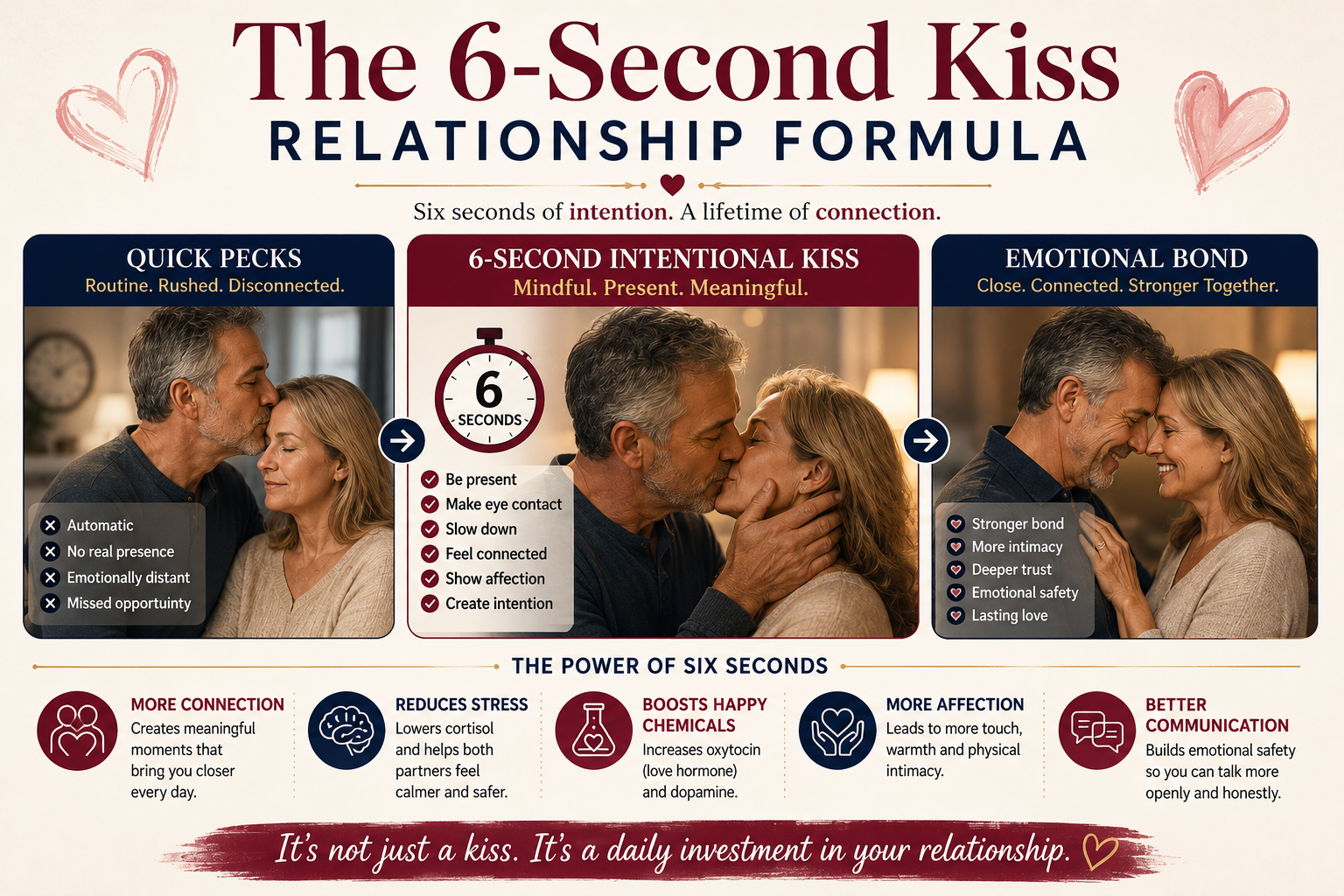
The “6-Second Kiss” Relationship Formula

A Quick Kiss Vs. A Mindful Kiss

Many couples rely on a short, fast kiss while they are going out the door or passing each other in the hallway. These are nice, but they are often rushed, such as:

  • A fast goodbye peck before work.
  • A distracted kiss while multitasking.
  • A routine goodnight gesture that is quick.

Even though these moments still matter, they don’t always create a deep connection. A longer, mindful kiss can change that experience. It slows everything down and allows you and your partner to feel the moment.

During this time, you can notice your breathing and your partner’s presence. The emotional tone changes, and as time goes on, this small shift can make affection feel more intentional and less automatic. This can strengthen the bond between you and your partner.

An Easy Way to Reconnect

A six-second kiss works great because even though it requires little effort, it delivers a strong emotional impact. You don’t have to talk, solve problems, or plan, but this can happen during:

  • A pause in the middle of a hectic day.
  • In a moment of shared presence.
  • As a physical reminder of emotional closeness.

Even when days are hard, this small act can soften the day and re-establish a stronger connection. It creates a sense of being together and can be grounding in long-term relationships.

What Can a Six-Second Kiss Do?

Taking time for a longer kiss might seem simple, but it can create different positive effects in a relationship, such as:

  • Building a daily ritual of a connection.
  • Increasing affection.
  • Inviting closeness.
  • Strengthening fondness.
  • Creating appreciation.
  • Reinforcing emotional responsiveness between partners.
  • Supporting positive emotional balance.
  • Calming the nervous system.
  • Reducing stress.
  • Creating a sense of emotional security.

Physical and affectionate touch has been linked to lower stress levels and increased bonding hormones. This means that doing small gestures is more powerful than you might know. As time goes on, these repeated, positive interactions help build a stronger emotional foundation in relationships.

Small Habits and Big Changes

One of the best things about this is how easy it is to do. Even just two 6-second kisses each day can add up to less than 2 minutes a week, but your emotions can be significantly impacted. As time goes on, it can:

  • Become a natural part of your daily routine.
  • Encourage feelings of closeness.
  • Help to reduce emotional distance before it starts.
  • Make affection feel intentional.

Consistency helps turn this simple act into a meaningful ritual that becomes part of your daily life. The more you do it, the more it reinforces the connection without needing more effort.

Final Thoughts: A Simple and Impactful Habit

A longer kiss isn’t just about technique; it’s about presence. It’s the way to get out of autopilot and reconnect with your partner, even briefly.

Even the smallest actions, when done consistently, can create a stronger bond in a relationship. A six-second kiss is one of the easiest ways to nurture the connection without needing more energy, effort, or time. It shows both partners that even in their busy lives, the connection can be put first.

Next time you kiss your partner, take time to slow down because those extra seconds can matter more than you realize.

Frequently Asked Questions

1. What is the six-second kiss?

The six-second kiss is an intentional kiss that lasts long enough to feel present, affectionate, and emotionally connected with your partner.

2. Why is six seconds important?

Six seconds is long enough to slow down, focus on your partner, and turn a simple kiss into a small moment of connection.

3. How can a six-second kiss strengthen a relationship?

It can create affection, reduce emotional distance, and remind both partners that they are loved, desired, and valued.

4. Is the six-second kiss only for romantic couples?

Yes, this concept is mainly for romantic partners who want to build closeness through intentional affection.

5. Should couples do the six-second kiss every day?

Many couples may benefit from making it a daily habit, especially during greetings, goodbyes, or before bedtime.

6. Can a six-second kiss reduce stress?

Physical affection can help partners feel calmer, safer, and more emotionally supported during stressful times.

7. What makes a six-second kiss different from a quick peck?

A quick peck is often automatic, while a six-second kiss is more mindful, present, and emotionally meaningful.

8. Does the six-second kiss improve intimacy?

It can help improve intimacy by creating a regular moment of closeness, affection, and emotional warmth.

9. When is the best time to practice the six-second kiss?

Good moments include before leaving for work, when coming home, before sleep, or after a difficult conversation.

10. What if one partner feels awkward trying it?

That is normal at first. Couples can start gently, laugh about the awkwardness, and let the habit become more natural over time.

11. Can the six-second kiss help couples who feel distant?

It may help rebuild small moments of connection, but deeper relationship issues may also need honest communication and consistent effort.

12. Is physical affection important in a relationship?

For many couples, physical affection helps communicate love, reassurance, attraction, and emotional safety.

13. What should couples focus on during the kiss?

Couples can focus on being present, slowing down, making the moment intentional, and showing genuine affection.

14. Can the six-second kiss replace communication?

No. It can support emotional closeness, but healthy communication, respect, and trust are still essential.

15. What if my partner is not comfortable with kissing often?

Respect their comfort level. Couples can talk openly and find other affectionate rituals, such as hugs, hand-holding, or kind words.

16. Can this habit help long-term couples?

Yes. Long-term couples can use small daily rituals like this to keep romance and emotional connection alive.

17. Why do small relationship rituals matter?

Small rituals create consistency. Over time, repeated moments of affection can help partners feel more secure and connected.

18. Can a six-second kiss improve communication?

It may help partners feel emotionally safer, which can make honest and calm communication easier.

19. What if we forget to do it every day?

That is okay. The goal is not perfection. The goal is to create more intentional moments of connection whenever possible.

20. What is the main lesson of the six-second kiss?

The main lesson is that small, intentional acts of affection can have a meaningful impact on emotional closeness.

Psychic Extrasensory Perception: The Mystery of the Mind

Psychic Extrasensory Perception

Times that Defy Logic

Most people have experienced a time when it goes against logic. Maybe you think about someone you haven’t talked to in years, and then they call you unexpectedly, or you walk into a room, and you feel tension without anyone saying anything. You might have even ignored the gut feeling and then regretted it and promised yourself that you would listen more next time.

These different experiences are often ignored or called a coincidence, but they happen so many times across cultures that it raises the question, “What if the mind is able to pick up more than we’ve been taught to believe?”

Extrasensory perception or ESP isn’t about predicting the future or giving the winning lottery numbers, but most of the time it shows up in a subtle, quiet, and personal way. When you understand that ESP isn’t about getting rid of logic but expanding it, you will embrace it even more.

Extrasensory Perception in Real Life

ESP isn’t just a dramatic time like seen in the movies, but it’s usually subtle and simple. This can feel like a thought that comes immediately to your mind, having a strong feeling about a certain situation, or a thought that comes out of nowhere and not being able to explain where it comes from.

Some people might feel this in their body first, like butterflies in their stomach, a tightness in the chest, or they might feel calm for no reason. Others see this as an emotional shift, such as feeling tension in a room before anyone says anything.

Because ESP feels so normal, people often ignore it. They think it’s overthinking, imagination, or just random. But later on, when something happens that lines up with what they felt, they realize it wasn’t as random as it seemed.

ESP usually doesn’t shout. It’s more like a quiet nudge.

ESP Isn’t Luck

A lot of people mix ESP up with instinct or coincidence.

Instinct comes from your brain picking up patterns from past experiences. It’s something your body learns over time to keep you safe.

Coincidences happen because life has a lot of moments, and sometimes things line up naturally.

ESP feels different. It often shows up without any clear reason. You might not have past experience to explain it, and it doesn’t feel random either. It feels personal, like it’s connected to what’s happening in your life right then.

Many people can think back to times when they had a feeling about a person, a decision, or a situation before they had proof. At the time, they brushed it off. Later, they realized they were picking up on something real.

ESP in History and Cultures

Long before psychology and modern science, people around the world saw intuitive ability as a normal part of being human.

In ancient Greece, intuition was often talked about as guidance from higher wisdom. In India, early spiritual writings described awareness that went beyond the physical senses. Many Indigenous cultures across North and South America used intuitive feelings for healing, travel, and everyday decisions.

Back then, ESP wasn’t strange or rare. It was simply how people understood the world.

It wasn’t until science began focusing only on what could be measured that intuitive experiences started being pushed aside. Not because they were proven wrong, but because they were harder to test and explain with tools and numbers.

ESP for Science and Measuring

Science works best with things that can be repeated the same way every time. ESP doesn’t usually work like that. Intuitive experiences are affected by emotions, stress, trust, and personal connection. When people feel pressured to “prove” intuition, it often fades instead of getting stronger.

That doesn’t mean ESP isn’t real. It just means it doesn’t behave like a machine. Some research groups, like the Rhine Research Center, have studied psychic experiences for years. Their findings are debated, but they continue because many results can’t be easily dismissed.

Types of Extrasensory Perception

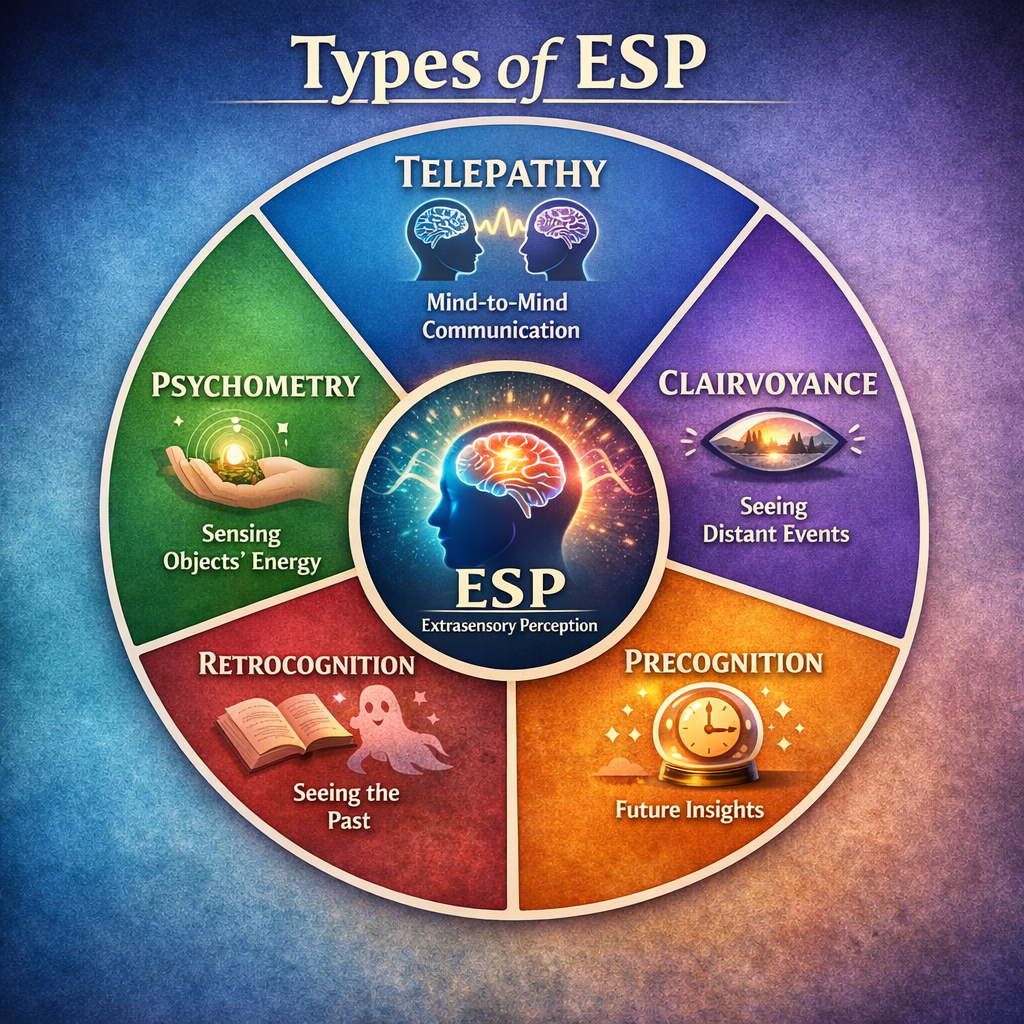
Types of ESP Wheel

Here are some different types of ESP:

Clairvoyance

Clairvoyance is not always literal visions, but it usually comes as mental images, symbols, or flashes of light instead of hallucinations. Some people might see something clearly in their mind before it happens.

Clairaudience

Clairaudience isn’t just about hearing voices, but it’s about getting information with inner dialogue, phrases, or verbal clarity that feels different than thought.

Some people experience this in the form of a sentence that feels authoritative and complete, and not a debate.

Clairsentient

This is the most commonly known form of ESP. Clairsentient people feel the truth in the signs from their bodies, such as tightness in the chest, warmth, heaviness, and calmness. Your body knows things before the mind catches up.

Telepathy

Telepathy doesn’t usually come in full sentences, but it’s more of an emotional transmission. It can feel like your mood changes from a distance, or you might know when someone needs you.

When you have a strong emotional bond with someone, the ESP can be stronger.

Precognition and Retrocognition

Precognition is sensing future events before they happen, and retrocognition is getting information about the past without someone telling you. This can come in dreams, insights out of nowhere, or feelings that only make sense later.

Using ESP Everyday

Most people use ESP but don’t really see it. You might know a meeting isn’t going to go well before you get there, or you know someone is being dishonest without proof. You might even make a decision that you don’t know why you made, but it benefits you later, even though it wasn’t logical at the time.

ESP isn’t separate from living, but it works within your everyday life. Here are some examples:

Doing it a Different Way

A woman changes her route to work at the last minute because something feels off, even though she can’t explain why. Later that day, she finds out there was a serious accident on the road she normally takes at the exact time she would have been there.

She didn’t know what was going to happen. She just listened to a feeling that showed up without logic.

Feeling Other People’s Stress

A man suddenly feels uneasy while at work, almost like something isn’t right. Hours later, he learns his partner was having a panic attack around the same time. There was no call or message beforehand.

Some people notice this happens more with those they are close to emotionally.

Ideas That All Come at Once

Many creative people talk about ideas that come suddenly instead of being slowly built. A song, solution, or plan just appears in their mind.

It doesn’t feel forced or thought through step by step. It feels like it arrives fully formed.

Ignoring Feelings and Learning More

A lot of people can think back to times they had a bad feeling about a choice but went ahead anyway. A job that looked perfect but felt wrong. A relationship that didn’t sit right from the start.

Later, they realized that feeling was trying to guide them.

Why Some People Are More Sensitive to the Spiritual World

Sensitivity isn’t just a gift that only a few people have, but it’s about having awareness, openness, and nervous system sensitivity.

People who are highly intuitive are people who often grew up having to read the environments that they were in closely. This could have come from creativity, trauma, or empathy that needed more perception. This doesn’t make this person special, but it shows that they are practiced.

Myths About Trusting ESP

One of the biggest myths around is that psychics know everything and are always certain. People who are intuitive doubt themselves constantly.

Another myth is that ESP can be controlled on command, but real intuition isn’t about performance but about responding.

Believing in ESP means that you aren’t looking for perfection because perfection is normally silenced by it.

How Life Takes Away ESP

When you are constantly stimulated, you have little room for hearing subtle signals. This can be screen time, stress, noise, and multitasking that overwhelm your intuition and your awareness. ESP works best in stillness and not chaos.

This is one of the reasons that intuition often comes when you’re taking a quiet walk, a shower, or just before you go to sleep.

Can You Develop ESP?

ESP doesn’t have to be forced, but it just has to be allowed. It can be things like:

  • Listening to your body signals.
  • Getting rid of mental noise.
  • Reflecting instead of dismissing the situation.
  • Trusting small signals or impressions.

These are ways to practice awareness without being pressured.

Psychics and ESP

Psychics aren’t more human than other people, but they’re just more aware and practiced. They have learned to listen to signals, get past emotions, and interpret impressions clearly. Ethical psychics don’t make promises of certainty, but they offer different perspectives.

Some people will go to psychics for guidance by going to platforms where intuitive skills are tested and refined, and follow ethical boundaries and guidelines.

Distance and ESP

Information isn’t a physical thing; it is emotional and intuitive signals that don’t go away because of distance. This is why some online psychic readings can be very effective. Connecting with someone doesn’t have to do with geography but with relationship and energy.

Believing in ESP

Trusting your intuition gets stronger when you listen to it. Intuition can improve your decision-making. It makes relationships deeper, builds self-trust, and gives strength. Even people who are skeptical see that they rely on ESP more than they realized; they just call it something else.

Where ESP Will Go in the Future

Artificial intelligence is about logic and data, and human intuition with logic and data becomes even more valuable. ESP isn’t about getting rid of logic or intelligence, but it complements it.

The future doesn’t belong to people who get rid of logical thinking or reasoning, but it works for those who integrate these things with inner knowing.

Final Thoughts: Extrasensory Perception Isn’t Mystical

Extrasensory perception isn’t just mystical, and it’s not based on talent. It’s a human sense that was never meant to get rid of logic but to support it. You don’t have to have blind belief, but being curious is enough.

The mind is full of mystery, and it doesn’t pick up too much, but we often miss it because we were taught not to listen enough.

Frequently Asked Questions

1. What is extrasensory perception (ESP)?

Extrasensory perception, or ESP, refers to receiving information in ways that seem to go beyond the five physical senses. It is often described as subtle inner knowing, intuitive signals, or awareness that appears without obvious logical proof.

2. Is ESP the same as intuition?

They are closely related, but they are not always described in exactly the same way. Intuition can include pattern recognition and body-based awareness, while ESP is often framed as receiving information that feels beyond normal sensory input.

3. Is ESP just coincidence?

Many people wonder that, but ESP is often described as feeling more personal and immediate than coincidence. It can show up as a strong inner nudge, a sudden impression, or a knowing that later makes sense.

4. What is clairvoyance?

Clairvoyance is often described as receiving information through mental images, symbols, or flashes of insight. It is not always dramatic and may feel more like seeing something in the mind than with the physical eyes.

5. What is clairaudience?

Clairaudience is the experience of receiving information as inner hearing, phrases, or clear internal words. People often describe it as sounding different from ordinary thought.

6. What does clairsentient mean?

Clairsentient refers to receiving information through feelings in the body or emotional impressions. It may show up as heaviness, calmness, warmth, tightness, or a strong sense that something is right or wrong.

7. What is telepathy?

Telepathy is usually described as mind-to-mind or emotion-to-emotion communication. It may feel like sensing what someone else is going through, especially when you share a strong emotional bond with them.

8. What is precognition?

Precognition is the sense of receiving information about something before it happens. This may come through dreams, sudden insights, or feelings that only make sense later.

9. What is retrocognition?

Retrocognition is receiving impressions about past events without being directly told about them. It is often described as sudden knowledge, images, or feelings connected to the past.

10. Can ESP show up in everyday life?

Yes. Many people experience it in ordinary ways, such as feeling tension before anyone speaks, sensing that a choice is wrong without clear proof, or suddenly thinking of someone before they contact you.

11. Why do people ignore ESP experiences?

People often dismiss ESP because it can feel so subtle and normal that it gets confused with imagination, overthinking, or random thought. Only later do some realize that the feeling carried useful information.

12. Is ESP about predicting the future perfectly?

No. ESP is not usually described as perfect prediction or total certainty. It tends to appear in small impressions, nudges, or signals rather than dramatic all-knowing answers.

13. Are some people naturally more sensitive to ESP?

Some people seem more sensitive, but sensitivity is often linked with awareness, openness, empathy, and paying close attention to subtle cues. It is not always treated as a rare gift reserved for only a few people.

14. Can stress block intuitive awareness?

Yes. Constant stimulation, stress, noise, and mental overload can make it harder to notice subtle impressions. Many people find that intuitive awareness is easier to access in stillness and quiet.

15. Can you develop ESP?

Many people believe you can strengthen your awareness by listening to body signals, reducing mental noise, reflecting on your impressions, and paying attention to small nudges instead of dismissing them.

16. Does ESP replace logic?

No. ESP is often framed as something that complements logic rather than replaces it. Many people see it as an added layer of awareness that works best when balanced with reason and common sense.

17. Why do intuitive feelings sometimes happen before sleep or in the shower?

These are moments when the mind often becomes quieter and less distracted. When mental noise lowers, subtle impressions may become easier to notice.

18. How do psychics relate to ESP?

Psychics are often described as people who have practiced noticing, interpreting, and trusting subtle impressions more consistently. The article presents this as a developed skill rather than a superhuman trait.

19. Can ESP work at a distance?

Many people believe it can. The article suggests that intuitive and emotional signals are not limited by physical distance in the same way ordinary communication is.

20. What is the biggest takeaway about ESP?

The biggest takeaway is that ESP is presented as a subtle human capacity that supports awareness rather than replacing thought. Curiosity, calm, and self-trust are often seen as more helpful than forcing results.

Twin Flames vs. True Partners: What Experienced Psychic Readers Really See

Twin Flames vs. True Partners

When Love Can Sound Like Poetry

Love can sound like poetry, and even songwriters will pick up their instruments to sing about love. When someone gets a psychic reading, they are normally asked questions about love, with one of the most common questions being “Is this person my twin flame or my true partner?”

Some people don’t really know that there is a difference between a Twin Flame and a true partner, but the difference can change your life. A Twin Flame is there to help you grow and to make changes, but they might not be there for your happily ever after.

A true partner is one that might not bring you the most exciting and dynamic relationship, but they help you build a certain kind of happiness and keep it forever. Psychics are asked this question all the time, and they see the difference in their insight can help clients to know the difference between a confusing heartbreak and destiny and how to avoid it.

If you want to know the difference between twin flames and true partners, keep reading this article. Psychics are able to tell the difference between these energies, and they can show you how to use the same wisdom in your own relationships. This article will also look at history, antidotes, spiritual tools, and even science from sources like  Psychology Today and  MindBodyGreen so that you could see that this isn’t just spiritual but also scientific.

What is the History Behind Twin Flame Connections?

The idea of twin flame connections isn’t something that is modern and seen throughout social media but it’s histories lie in ancient times. The roots of the twin flame relationship go back to ancient mystic and philosophies such as Plato’s who talked about “symposium” and described how humans are a whole spirit and that they are split in half by the gods and one person is always seeking to find the other half of their soul. This is also seen in Hinduism which speaks of Ardhana Ishvara who is female and male and then the Kabbala culture that speaks of soulmates that split apart from one single soul.

In the 20th century, Western metaphysical people changed the idea to the twin flame concept. Twin flames are different than soul mates who are meant to bring you peace and harmony. Twin flames are mirrors of someone, and they help reflect the shadow self as much as they help reflect your light.

Psychics today agree that twin flames are real, but they’re not normally the romance that people are hoping for. Twin flames show up to help encourage their other half to grow, which often causes a lot of challenges and can lead to heartbreak.

One psychic said, “A twin flame isn’t a person that you go and build a home with and add a white picket fence. But there’s someone who will set the white fence on fire, so you have to learn why you ever built this home in the first place.”

True Partners Make You Feel Like You’re Home

Psychics will always define a True Partner differently than they will a Twin Flame. Where a Twin Flame relationship is normally challenging and dramatic, a True Partner is someone that is reliable, always there for you, and very loving. They are less electric and more like light, gentle and consistent in how they feel about you.

Here are some signs that you might notice with a true partner connection:

  • Your energy field is smooth, and you don’t feel like you’re always clashing with someone.
  • The communication is easy even when there are conflicts.
  • Supports you to grow but doesn’t force you to face past things like hurt and trauma.
  • The relationship feels safe and open, and you don’t feel like you are constantly walking on eggshells.

According to MindBodyGreen, there are relationships that go through healthy stages such as infatuation, trust and then long-term commitments. Psychics agree with this and see that true partners normally come when a person is stable and emotionally ready for a real relationship.

How Do You Know If They Are a Twin Flame or True Partner According to Psychics?

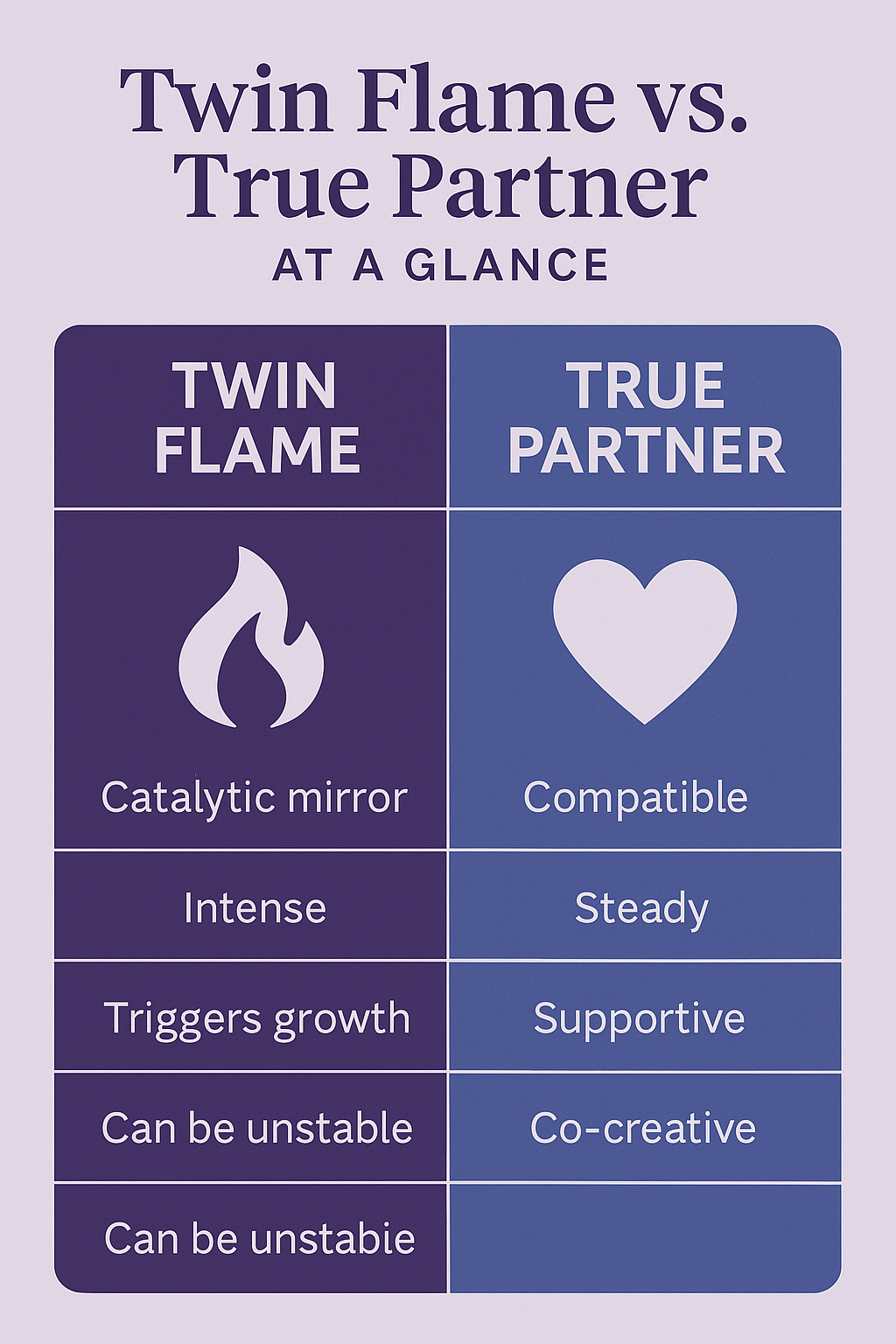
Twin Flame vs. True Partner at a Glance

Here are some real-life stories from psychics that show the difference between a twin flame and a true partner.

Up and Down Relationship

One client went in to talk to a psychic and insisted that her ex was her twin flame because they had so much passion that it was almost impossible to get over. When the psychic looked at her energy, she saw that there were repeating patterns of conflict and then reconciling the relationship, which is a classic twin flame trait. This reading helped the client to know that even though the relationship was passionate and intense, that it didn’t mean it was her destiny. A few months later, she moved on, realizing that the relationship was more like a karmic bond than a true life partner connection.

Heartbroken By a Fiery Relationship

A man asked the psychic about a fiery relationship that had ended up breaking his heart. The psychic felt that there was a steady and relaxing energy around a certain colleague that the man worked with. A few months later, when the man came back, he told the psychic that he became engaged to that colleague. He thought it was funny how he almost looked past the fact that this was his true partner.

Twin Flames Pushing Past Trauma

A lady came in to talk to a psychic and asked the psychic if the person she was with was “the one.” The psychic confirmed to her that this person was her twin flame, which was a soul to help her get past old trauma. This wasn’t someone that she was supposed to marry. By having this clarity, the lady was able to stop allowing the chaos to take over her life.

When the Connection Seems Too Easy

A client stopped talking to her long-term boyfriend because she felt that the relationship seemed too easy. When talking to her psychic, the psychic explained to her that love doesn’t always have to be hard in order for it to be real love. She explained to her that having an easy relationship was the trait of a true partner because it doesn’t mean that it lacks in importance, but that the relationship is meant to make life better.

These real-life stories from psychics show that there’s a real difference between a twin flame and a true partner.

What Psychics See When Looking at the Energy Signature of Relationships

When psychics look at any kind of relationship they look at the energy signatures of that person. Here are some kinds of relationships that psychics often talk about:

  • Twin flames: The energy behind this relationship can be like two storms that are crashing. These relationships feel electrical but aren’t stable.
  • True partners: The energy behind this kind of relationship is balanced and peaceful. They harmonize together like musical notes to make a beautiful song. This relationship feels safe and nurturing.

A twin flame relationship can become a toxic relationship. People think that the pain that they are feeling is part of the passion. A good psychic can direct a client towards healthier truths about relationships.

Emotions and Experience: Dealing with Fireworks and Fire

Being in a Twin Flame relationship is a relationship that’s going to have a lot of ups and downs. This can be both exciting and terrifying. When the relationship is good, it’s like euphoria, but when the relationship is low, it leaves you feeling broken. Twin Flame relationships come into your life at different stages to help you open up.

In a true partner relationship, this is like fire – it’s a relationship that sustains and one that stays steady and warm for you. It won’t fade away just as it gets good, but it’ll be there to keep you safe even when things get hard. Psychics sometimes joke that a twin flame relationship will burn your marshmallows, while a true partner helps you to make a special treat like s’mores.

Psychic Tools to Use to Know the Difference Between a Twin Flame and True Partner

Psychics don’t just use their intuition when they are trying to help you to know what kind of relationship that you’re in, but they also use other tools. Here are some of the tools that your psychic might use:

  • Tarot cards: When doing a reading, a twin flame might show up as these cards:
    • The Tower.
    • The Devil.
    • The Moon.

A true partner might show up as these cards:

  • The Lovers.
  • Two of Cups.
  • Ten of Pentacles.
  • Astrology: Twin flames can have intense oppositions or show up as conjunctions that intensify your growth. A true partner will have charts that show stability and complement your life.
  • Numerology: Sometimes a twin flame will show up as repeating or mirrored numbers like 2:22. A true partner will have numbers that align with your path, and you will share a purpose with them.
  • Akashic records: Some psychics will do an Akashic records reading to see if the relationship you are in is a karmic bond or a genuine connection.

Does Knowing the Difference Even Matter?

Knowing the difference between a Twin Flame and a true partner can help you to not have to live through painful relationships. Many people get stuck in a Twin Flame relationship because they have so many ups and downs and they stay in the toxic relationship because they believe that having chaos means that this person is their destiny.

According to  Psychology Today, a healthy relationship is built on stability and trust and not on drama or pain. Twin flame relationships are there to teach people lessons and to help them grow and a true partner is there to help them to live their best lives.

What Do Psychics Tell Clients?

Here are some things that psychics will tell their clients when talking about love and relationships:

  • Don’t worry so much about labels but pay attention to how the relationship makes you feel.
  • If the connection is always painful, it is probably a twin flame lesson and not a true partnership bond.
  • A relationship that feels safe and supportive is probably a true partner.
  • Talk to a psychic to get clarity when you feel that your emotions or your intuition is clouded and confused.

Final Thoughts: Twin Flame Versus True Partner Love

Twin flame relationships and true partner relationships are there to help you to grow and to support your soul, but in totally different ways. One helps you to see what you are missing and what you need to change, and the other helps you to see that things can be happy and easy.

Both of these relationships are important for growth but both of them aren’t meant to last forever. Psychics will tell you that you don’t have to deal with constant drama to prove that the relationship is meant to be. Sometimes the best connections that you have are the ones that are consistent, kind, loving and natural.

If you are someone that is confused about love, it can be confusing, but this is one thing that is clear. You don’t have to go after relationships that will burn you but find ones that have a constant light that keeps burning for you even after the heat dies down.

FAQ:

1. What is the difference between a twin flame and a true partner?

Readers describe twin flames as catalytic mirrors that intensify growth, while true partners are compatible companions who co-create a stable, healthy life. One can be both, but often they are different relationships with different purposes.

2. Why do twin-flame connections feel so intense?

They amplify shadow and light, triggering rapid lessons. You may feel instant familiarity, telepathic vibes, or push–pull dynamics because the bond spotlights unfinished healing work.

3. How do psychics identify a true partner energy?

Signs include consistent reciprocity, future alignment on timing and values, low drama, and a shared capacity for repair after conflict. The energy reads as steady, safe, and forward-moving.

4. Can a twin flame become a healthy long-term partner?

Yes, if both people do the inner work, set boundaries, and choose mutual growth. Without repair skills, the same intensity that awakens you can also destabilize you.

5. Are runner–chaser patterns a guarantee of twin flames?

No. Inconsistent behavior can signal attachment injury, not a sacred label. Readers look for growth outcomes and consent, not just intensity.

6. What questions help clarify which connection I’m in?

Ask: Do we repair well? Do we share a timeline? Do I feel safer, clearer, and more myself? Does this love expand my life beyond the relationship?

7. How do timing and free will shape outcomes?

Timing windows appear in readings, but choice governs the result. Two compatible paths can miss each other if actions and readiness don’t align.

8. What are red flags that it’s not a true-partner path?

Chronic anxiety, isolation from support, cyclical breakups without change, love-bombing followed by withdrawal, or giving up core needs to keep the bond.

9. What practical steps help if I’m in a twin-flame loop?

Pause contact, regulate your nervous system, work with a therapist or coach, and ask a reader for actionable next steps that prioritize wellbeing over reunion fantasies.

10. How can a reading support me in choosing well?

A quality reading offers pattern language, timing checkpoints, and behavior-level guidance so you can test the path in 7–30 day experiments and decide with clarity.

General Statements of the Barnum Effect

General Statements of the Barnum Effect

Have you ever thought about a psychic or a fortune teller and how they can seem to know everything about you without ever meeting you? Or have you ever taken a personality test, and it seems to be so specific to what is going on in your life? If you have ever experienced this, chances are that you have experienced the Barnum Effect. This is where people can take generalized and vague statements, and they can apply them to their lives. This makes it feel personal for you. This is based on psychology, and it is best that you know and understand what it is so that you know how to address it if it shows up in your life.

What Is the Barnum Effect and Where Did It Come From?

The Barnum Effect is what happens when someone hears a vague, general statement and thinks it’s specifically about them, even though it could apply to almost anyone. This psychological pattern shows up all the time, especially in horoscopes, online quizzes, and psychic readings. It plays into our natural desire to feel seen and understood.

The name comes from P.T. Barnum, a famous American showman known for saying his circus had “something for everyone.” That idea, offering something broad that people interpret as personal, is exactly what this effect is all about. While Barnum didn’t create the idea himself, his name stuck to the concept because he used similar tactics to entertain and draw in crowds.

The term was first used by psychologist Paul Meehl in 1956, but the effect was actually studied a few years earlier by another psychologist named Bertram Forer. In 1948, Forer gave his students a fake personality test, then handed them all the same results with vague statements like, “You sometimes feel insecure” or “You tend to be critical of yourself.” The students were asked to rate how accurate the statements were, and most gave them a high score, an average of 4.3 out of 5. That simple test showed how easily people can believe a general message is meant just for them.

What Makes It So Convincing?

Certain patterns show up in Barnum-style statements. These are the little tricks that make them feel personal:

  • They’re vague – The language is open-ended and can mean different things to different people.
  • They mix good and bad – Including both strengths and flaws makes the description feel “balanced,” which makes it more believable.
  • They sound positive – Most of the time, the messages are slightly flattering, which taps into our need for self-esteem.
  • They invite interpretation – You fill in the blanks with your own experiences, which makes the statement feel even more specific to you.

Some classic examples of Barnum statements include:

  • You want others to see you in a good light.
  • You have untapped potential you haven’t fully explored.
  • At times, you’re outgoing, but at other times, you need space.
  • You’ve had your share of challenges in relationships.
  • You value your independence but sometimes feel unsure about your choices.

Even just reading those probably made you nod a little; they seem personal, even though they could apply to almost anyone.

Where You’ll Notice the Barnum Effect

This effect pops up more often than you think. It’s everywhere, from entertainment to marketing to everyday conversations:

Astrology and Horoscopes

Horoscopes use general statements that feel spot-on, but they’re crafted to apply to a broad group of people. That’s why two different zodiac signs might read the same message and both think it fits.

Fortune Telling and Psychic Readings

Many psychics use broad emotional statements and let the person receiving the reading fill in the details. It creates the feeling of a deep personal insight, even if the statement was generic.

Personality Quizzes

Those “What kind of leader are you?” or “Which career fits your soul?” quizzes often pull from the same set of broad descriptions, yet people still find the results compelling.

Marketing and Advertising

Marketers use the Barnum Effect to make products feel personalized. Phrases like “Made for dreamers like you” or “This is for the bold and brave” create the illusion that a product matches your identity.

Why We Fall for It

There are a few psychological reasons the Barnum Effect works so well:

Confirmation Bias

We notice what fits and ignore what doesn’t. If something lines up with what we already believe about ourselves, we’re more likely to accept it, even if it’s vague.

Self-Serving Bias

We like hearing things that make us feel good. If a statement says something flattering, we’re naturally more inclined to believe it’s true.

Desire for Meaning

As humans, we want things to make sense. We try to find patterns, even when there aren’t any. That makes us more likely to connect emotionally to things that sound meaningful.

Real-World Consequences

While the Barnum Effect might seem harmless, especially in entertainment, it can cause problems when it’s used to mislead people. Here’s how:

  • Scams and Manipulation – If someone is using vague emotional language to win your trust, like in a scam or con, the Barnum Effect can make you more likely to believe them.
  • False Beliefs – People may start believing in pseudoscience or unproven ideas because the language used “feels” true, even if there’s no real evidence.
  • Weakened Critical Thinking – The more we fall for vague statements, the less likely we are to question them. This can make us more vulnerable to manipulation over time.

How to Avoid Being Misled

Understanding the Barnum Effect doesn’t mean you can’t enjoy your horoscope or take personality quizzes, but it does mean you can spot when something’s too general to be meaningful. Here are a few ways to stay sharp:

  • Ask yourself: Would this apply to most people I know?
  • Look for specifics: If a statement could fit anyone, it’s probably not that insightful.
  • Check your emotions: Are you believing it because it feels good, or because it’s actually useful?
  • Pause before acting: Don’t make big decisions based solely on general advice that could apply to anyone.

Final Thoughts

The Barnum Effect is one of those subtle psychological quirks that reminds us how much we all want to feel special and understood. It’s not a weakness, but it’s human. But knowing about it gives you power. It helps you recognize when someone’s trying to connect with you using vague flattery or when a message isn’t as personal as it seems.

Being aware of this effect lets you enjoy things like astrology, personality tests, or marketing in a more grounded way, without being swept up by it. When you understand how the Barnum Effect works, you can still feel seen while keeping both feet on the ground.

FAQ’s

Here are some commonly asked questions:

  • What is the Barnum Effect?

This is a cognitive bias where people will give vague or general statements that describe a personality. It is named after the famous guy, P.T. Barnum, who would tell his audience that he had something for all of them.

  • Where Will You See the Barnum Effect?

This can be seen in psychic readings, personality quizzes, horoscopes, and more. This might even be a focus of motivational speeches. It can be positive to make people feel connected to the person saying it.

  • How Do I Know if The Barnum Effect is Being Used?

When the results seem too accurate or could apply to a bunch of different people, such as saying, “You want to have validation from others,” then this is the Barnum Effect.

  • How Are People Fooled by the Barnum Effect?

People can be fooled by making decisions based on general or false information.

Ethical Psychic Readings: Consent, Limits and Clear Terms

Seated reader with eyes closed between lit candles.

Updated

An ethical psychic reading should leave you free to disagree, decline a question and stop spending. Look for clear terms, respectful boundaries and honest uncertainty. Warmth, confidence or a striking anecdote does not establish that someone can predict events or discover private facts.

This guide offers standards you can use to assess conduct. It does not certify a practitioner or verify paranormal ability.

Agree on the service before the session

A reader should explain what you are buying: a conversation, a card interpretation, a written response or another clearly described service. Ask what the session includes, which subjects the reader will decline and whether an appointment is recorded. You should be able to understand the offer without accepting the reader’s spiritual beliefs.

Set a maximum spend before starting. For a timed service, check the rate, minimum charge, how extra minutes are approved and how the session ends. For a package, check the number of sessions and any renewal terms. An unclear answer is a reason to pause the booking.

Keep impressions separate from established facts

A responsible reader can describe an impression as an impression and admit that it may be wrong. They should not present guesses about illness, death, pregnancy, infidelity or another person’s intentions as verified knowledge. Delivering a frightening prediction gently does not make the prediction reliable.

In its guidance for UK advertisers of spiritual and psychic services, the Committee of Advertising Practice stresses evidence for objective claims, genuine testimonials and clear guarantees. It also warns against exploiting vulnerable consumers. This advertising guidance provides a useful reference for evaluating claims; it is not a worldwide practitioner licence or proof of accuracy.

Ask what supports an advertised success rate and what was counted as a miss. A dramatic story with no checkable record is not enough. A testimonial may describe someone’s satisfaction, but it does not independently verify the explanation for what happened.

Make consent specific and ongoing

Agreeing to a reading does not mean agreeing to touch, recording, public discussion, a testimonial, follow-up marketing or every possible topic. Those choices should be made separately. A reader should accept “I do not want to discuss that” without treating it as resistance, bad energy or a reason to charge more.

Respect also includes belief. A practitioner should describe their own approach honestly and ask which language you are comfortable using. Quietly relabelling a claimed spirit guide as an angel to gain your trust misrepresents the service.

Respect people who are not in the room

A session cannot establish a partner’s private thoughts, a child’s future sexual orientation or a stranger’s medical condition. Focus on your own observations, choices and boundaries. Do not use a reading to justify accusations, surveillance or contacting someone who has asked for distance.

For example, an appropriate change of question is: “What have I actually observed, and what conversation or boundary would help me?” A psychic explanation should not override a person’s own account of their identity or wishes.

Ask how personal information is handled

Before sharing sensitive details, ask whether the provider keeps notes, who can access recordings and how long records are retained. Check how to request deletion and what the provider says about exceptions to confidentiality. The phrase “everything is sacred” is not a useful explanation of data handling.

Do not assume an anonymous anecdote is harmless. A combination of dates, family events and relationship details can still identify someone. A practitioner who wants to publish your experience should ask permission for that specific use and show you what will appear. A fictional teaching example should be labelled as fictional.

Recognize when the reader should step back

Psychic credentials do not establish medical, mental-health, legal or financial qualifications. A reader should not tell you to stop treatment, take a financial risk or return to an unsafe relationship because of a prediction. They can acknowledge that the question needs a suitably qualified professional or a practical source of support.

They should also accept that you may prefer another form of reflection. Our guide to realistic self-talk and personal boundaries offers prompts that do not depend on a reader’s approval.

Expect a clear response when the session is unhelpful

Ask about cancellations, dissatisfaction and refunds before paying. A provider should explain the applicable terms without promising a guaranteed outcome. If a reader says they cannot continue, the next step should follow the agreed policy; it should not become a story about your blocked energy that requires a new purchase.

You can say, “This is not useful to me. Please stop the session and explain the charges so far.” Keep the booking terms and payment record. If you encounter threats, escalating fees or pressure to pay for protection, see psychic scam warning signs and what to do next.

A short checklist to use before booking

  • Scope: Can I explain what I am buying and what is outside the service?
  • Cost: Do I know the full rate, spending limit and cancellation terms?
  • Choice: Can I decline a topic, stop the session or refuse another purchase?
  • Privacy: Do I know what is recorded, retained or shared?
  • Claims: Does the provider distinguish belief and interpretation from evidence?
  • Accountability: Is there a clear way to raise a concern and keep a record?

Use these questions to judge observable behaviour over time. An ethical label is meaningful only when the provider’s conduct supports it.

Asking a Psychic 101 Questions

Asking a Psychic 101 Questions

Maybe you have recently decided to go and get a psychic reading. Of course, you need answers just like everyone else does, but how do you know what to ask? There are psychics that you can talk to, but you might not know how to even begin. Of course, there are ways that you can ask questions, and here are some basic ideas:

Direct Questions

Ask direct questions and make sure that you are asking questions so that your psychic can focus on the topic that you are concerned with. If you have questions about your relationship, don’t start with career questions.

Open-Ended Questions

Asking open-ended questions can let the psychic go deeper with your conversation without leading to the answers that you want to hear.

Yes or No Questions

Always avoid asking yes or no questions because these will not give you details into the situations that you are dealing with.

Of course, there are no right or wrong questions that you can ask a psychic, but there are ways that you can phrase your questions so that you can get the answers that you are seeking.  Keep reading to find out the best 101 questions to ask your psychic!

Start with These Foundational Questions

  • What energies are currently influencing my life, and what’s ahead in the coming months and years?
  • What important lessons or messages should I keep in mind right now and for the near future?
  • Do you see me going through any big life changes soon?
  • How can I learn to trust my own intuition better?
  • Are my Spirit Guides trying to share anything with me?
  • What lessons is my soul working through right now?
  • What personal growth work should I focus on to help me find future success?

Gain Clarity on Career and Finances

  • If I pursue this career path, will it bring happiness and financial stability?
  • What does the future of my career look like? Is there room for growth?
  • What current obstacles am I facing at work, and how can I overcome them?
  • What can I expect for my career and financial well-being over the next year?
  • When would be the right time to make a career move?
  • Am I working in a field that aligns with my soul’s purpose?
  • How can I turn my passions into a successful career?
  • Is this a good time to ask for a raise or promotion?

Explore Family Planning and Well-Being

Pregnancy & Parenthood

  • Do you see children becoming part of my future?
  • Is my partner emotionally ready to start a family?
  • What can I do now to prepare myself for parenthood?
  • Are there any new family commitments or changes coming soon?

Health & Wellness

  • What steps can I take to improve my physical and emotional health?
  • How do you see my energy levels over the coming months, and how can I protect my well-being?
  • What practices can help me manage stress and reduce anxiety?
  • When will I feel confident and comfortable in my body again?

Find Guidance for Love and Relationships

If You’re in a Relationship

  • Is my partner truly happy in our relationship? If not, what’s troubling them?
  • What is the current energy of our relationship?
  • How can I show up as a better partner?
  • Is my partner thinking about our future, like marriage or starting a family?
  • Are we truly a good match for each other?
  • What challenges might we face together, and how should we handle them?
  • How do our astrological signs affect our relationship dynamics?
  • How can I regain my personal power if the relationship feels controlling?
  • Our relationship feels distant. How can we rekindle the physical connection?

If You’re Single and Searching

  • What personal work can I do to attract a healthy, loving relationship?
  • Does the person I’m interested in feel the same way about me?
  • When will I meet someone special, and how will I recognize them?
  • Is there a chance I’ll reconnect with someone from my past?
  • How am I unconsciously sabotaging my relationships, and how do I stop?
  • Have I already met my soulmate?
  • Am I truly compatible with the person I’m interested in?
  • Will I hear from the person I’m thinking about soon?
  • Am I wasting my time on this connection?
  • How can I heal emotional wounds from past relationships?
  • What do I need to do to attract genuine, lasting love?

Improve Connections with Family and Friends

  • How can I better support a family member in need?
  • Is it possible to heal a strained relationship from my past?
  • Why is this person acting distant or cold toward me?
  • How can I improve communication with the people I care about?
  • What steps can I take to create healthier relationships with my family?
  • What kind of energy is missing from my friendships and family circle, and how can I find it?
  • Is someone close to me hiding something important?
  • How can I better understand and support my child’s emotional needs?
  • How can I build stronger bonds with the children in my life?
  • What’s the best way to let go of resentment toward my family and rebuild trust?
  • Are the people closest to me truly supportive, or am I being quietly judged?

Get Clear on Timelines

  • When can I expect this event or opportunity to unfold—days, weeks, or months?
  • Will things move forward by a specific holiday or important date?
  • What factors could change or delay the timeline I’m hoping for?
  • What is a realistic timeframe for this to happen?
  • Will this unfold in a way that works for me and my life plans?

Ask for Spiritual Guidance

Discover Your Life Purpose

  • What is my life’s true purpose, and how do I start fulfilling it?
  • Are the people I surround myself with helping or hindering my progress?
  • What lessons am I meant to teach others?
  • What actions should I be taking now to create the life I really want?
  • What’s holding me back from discovering my true purpose?

Learn from Your Past Lives

  • Is there a karmic lesson I’m still working through?
  • What karma from a past life am I carrying into this one?
  • What can you tell me about who I was before this life?
  • Are there people in my life today who are connected to my past lives?
  • How is the cycle of my existence progressing through lifetimes?
  • What lessons do I need to learn from my past to stop repeating the same patterns?
  • Which past life has the biggest influence on my current life?

Connect with Loved Ones Who Have Passed

  • Can you help me know for sure when my loved one is near?
  • What message are they trying to send me?
  • How can I keep the lines of communication open?
  • What signs should I watch for to know they’re reaching out?
  • Have my loved ones found peace on the other side?

Understanding Spiritual Activity and Hauntings

  • Is there an active spirit in my home, and are they watching over me?
  • How can I respectfully let a spirit know I didn’t mean to intrude?
  • Why is this spirit still lingering in my space?
  • What rituals or tools can I use to cleanse my home of unwanted energy?
  • Is this spirit benevolent, or should I be cautious?
  • Is the spirit attached to me personally, or is it connected to my home or the land it sits on?

Connect with the Pets You Love

  • Is my pet happy, and is there anything they want me to know?
  • Will I be reunited with my pet after they pass on?
  • What’s my pet’s energy like right now?
  • How can I connect more deeply with my pet or one that has passed?
  • Am I creating a loving and comfortable environment for my pet?
  • Did my pet experience trauma before I adopted them, and how can I help ease their anxiety?

Unlock Your Psychic Gifts

  • What practices should I try to strengthen my psychic abilities?
  • How can I tune in to my intuition more clearly?
  • What hidden blocks are keeping me from accessing my intuition?
  • Can you help me figure out what my gifts are and how to work with them?
  • What meditations will help me connect with my higher self?
  • How can I connect with my Spirit Guides to develop my gifts?
  • What tools should I use to sharpen my abilities?

Final Thoughts

Each reading will be personal, and the questions that you ask should be ones that you feel in your spirit. The more specific the questions are that you ask, the better the answers will be for you. Make sure you prepare your questions, and you get the truth you’re seeking!