


A vivid dream, a sudden hunch or a feeling that a conversation matters can spark curiosity about your psychic gifts. If intuition is part of your spiritual life, you can make room for it through a steady practice of noticing, reflecting and checking what you learn.
Begin with curiosity about your experience rather than pressure to prove a talent. You do not need to force an image, hear a message or have the same experience as someone else. A practice should leave room for ordinary explanations and for saying, “I do not know yet.”
Choose one kind of experience to explore
Spiritual communities use the word clair, meaning clear, in several labels. These names describe how people interpret an impression; choosing a label does not establish its source.
1. Inner imagery
Often called clairvoyance. Notice an image in your imagination or dream. Describe its actual details before deciding what it means.
2. Felt impressions
Often called clairsentience. Notice a feeling and the setting around it. Ask another person about their experience instead of assuming their emotions have entered your body.
3. Words or sounds in the mind
Often called clairaudience. Record a remembered phrase, song or thought as you experienced it. Leave its origin open.
4. A sudden sense of knowing
Often called claircognizance. Write a hunch precisely, then identify what information could support or challenge it.
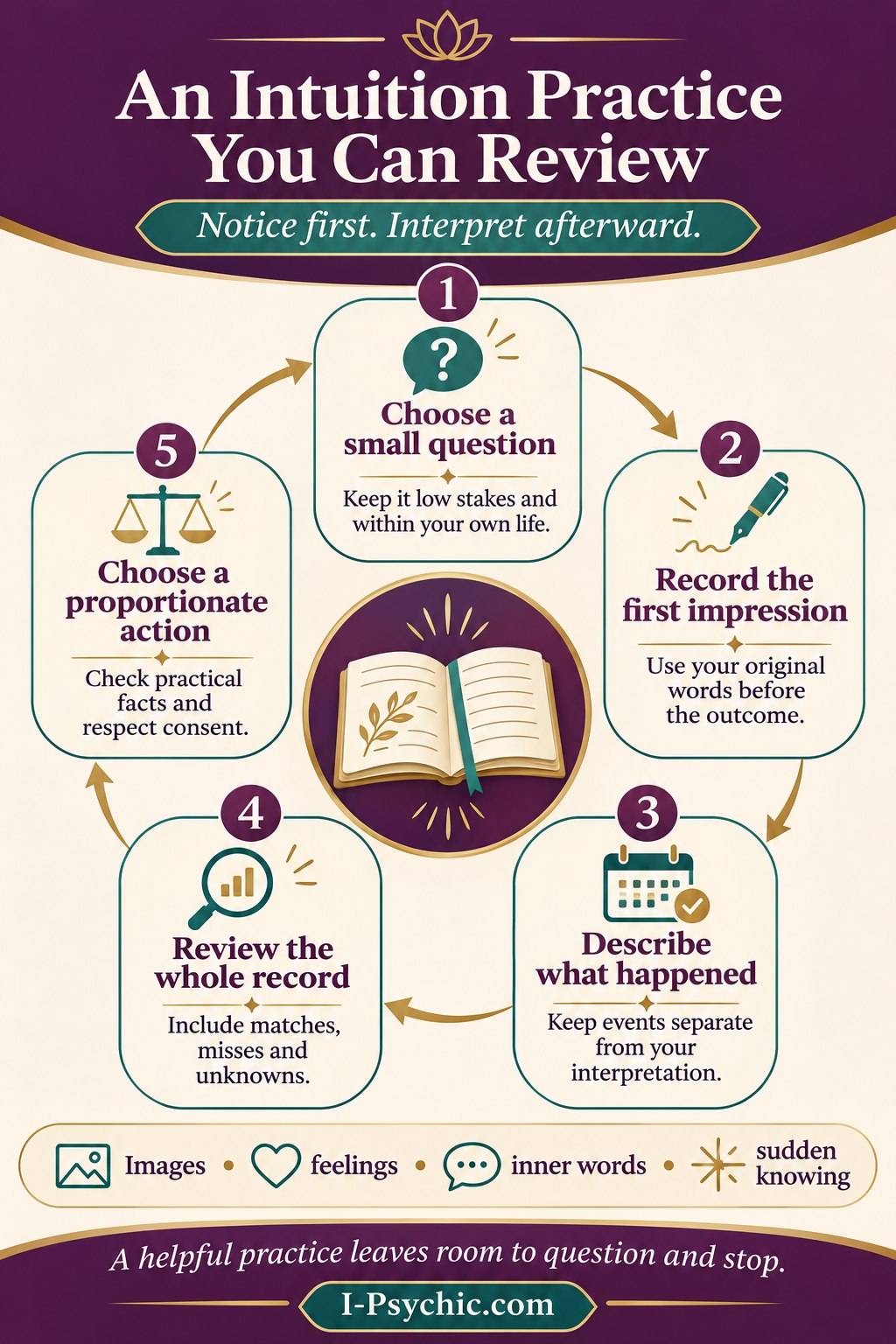
Build a small routine you can review
- Settle into your surroundings. Sit comfortably, look around and notice your breathing without changing it. Keep your eyes open if that feels better. A few quiet minutes are enough.
- Pick a low-stakes subject. Try a reflection about your own day or a creative idea. Avoid using a practice to diagnose illness, accuse a partner or make a financial commitment.
- Capture the impression before the outcome. A phone note works well. Include the date, exact wording and what would count as a match. Keep the original rather than editing it later to fit events.
- Review everything you recorded. Include misses, broad statements and uncertain results. “I expected a call, but none came” belongs beside a memorable match.
- Choose a proportionate action. You might ask a clear question, test a creative idea or get more information. An impression can begin an inquiry without settling it.
For example, “Someone will contact me” is broad enough to fit many days. A more useful record identifies who, what kind of contact and a time window before anything happens. Even a specific match can have more than one explanation.
Free impression-log template
Copy these headings into a private note. Use a separate entry for each impression.
- Before: date, setting, sleep and mood; exact impression; information I already had.
- Check: what would count as a match, a miss or an unresolved result; when I will review it.
- After: what actually happened; evidence available; another possible explanation.
- Learning: what I would do differently; one ordinary next step.
Example: “I felt tension before a meeting. I already knew a deadline was close. A colleague later said they were rushed. Next time I will ask about timing rather than assume I know how everyone feels.”

Use dreams without turning them into instructions
After waking, record a few details while they are fresh: the people, setting, emotion and a striking image. Ask what the image brings to mind in your own life. Repeated themes may be worth reflecting on, but a dream does not reveal someone else’s private thoughts or require you to contact them.
If you remember nothing, leave the entry blank. Avoid disrupting sleep to chase a vivid dream. Our guide to listening to your psychic self offers another starting point for reflection.
Make boundaries part of the practice
You can use a protective-light visualization as a personal symbol of a limit: “I can listen without taking responsibility for every problem.” Pair the image with an actual choice, such as ending a conversation at an agreed time or taking a break from a crowded room.
Ask permission before discussing an impression about another person. Accept a refusal and avoid announcing predictions about their health, pregnancy, death or relationship. A caring intention does not remove their right to privacy.
Be cautious about a teacher who guarantees powers, tells you every doubt is a blockage or pressures you to buy repeated cleansing sessions. You remain free to question an interpretation and stop spending. Our guide to checking a gut feeling explores situations where more information matters.
Frequently asked questions
1. Where should a beginner start?
Choose one low-stakes experience, describe it clearly and review what happened later. A few minutes of reflection can be enough.
2. Do I need to decide which clair I have?
No. You can describe images, feelings, words or hunches without assigning yourself a permanent label.
3. Does a strong feeling guarantee accuracy?
No. Strength of feeling does not establish what caused it or whether an interpretation is correct.
4. Should I record only successful impressions?
Keep misses and uncertain results too. Reviewing the complete record gives a more useful picture than saving only memorable matches.
5. Can I keep the log on my phone?
Yes. Use a private note, preserve the original wording and avoid including another person’s sensitive information.
6. What makes an impression specific?
State the subject, expected event and time window before the outcome. Broad wording is harder to assess.
7. What if I cannot remember dreams?
Leave the entry blank. You do not need vivid dreams to have a reflective spiritual practice, and sleep should take priority.
8. Do dreams reveal another person’s feelings?
A dream can help you explore your own associations. It does not establish another person’s private feelings or intentions.
9. Can I use a visualization for boundaries?
Yes, as a personal symbol. Support it with practical limits around time, privacy, contact and what help you can offer.
10. Should I tell someone every impression I have about them?
Ask permission first. Respect a refusal and avoid alarming predictions about sensitive parts of their life.
11. Do I need crystals or cards?
No. Optional tools can provide imagery or a focus, but a note and a clear question are enough for these exercises.
12. How long should I practice?
Use a short period that feels comfortable. There is no required intensity or deadline, and you can stop whenever you wish.
13. Does dizziness mean I am absorbing energy?
Dizziness does not identify a spiritual cause. Pay attention to your body and seek appropriate care for concerning or recurring symptoms.
14. What should I look for in a teacher?
Clear costs, realistic descriptions, consent, privacy and freedom to disagree or leave are useful starting points. Avoid guarantees and pressure.
15. What counts as progress?
Clearer observations, more honest reviews, stronger boundaries and thoughtful decisions are worthwhile changes even when a cause remains uncertain.